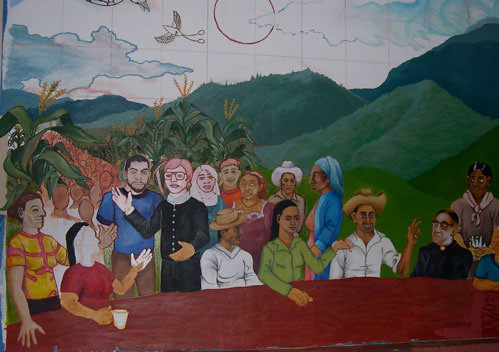
(Español) TERMINAMOS EL MURAL DE TOROLA 2010

Sorry, this entry is only available in Español.

Walls of Hope receives prestigious Transnational Cultural Remittances Award

It is my privilege to announce that Walls of Hope has just received the prestigious Transnational Cultural Remittances Award sponsored the National Association of Latino Arts and Culture and the Ford Foundation. The Transnational Cultural Remittances (TCR) program is designed to strengthen the exchange of art and culture between communities linked by people’s migration from one country to another. The award funds will be used to create a new community art project in Guatemala. Five art teachers from the school of art in Perquin will travel to Guatemala and collaborate with the Community Studies Team of Psychosocial Action to create art and mural workshops on historical memory with victims of political and sexual violence from the Guatemalan armed conflict (1960-1996). The war was particularly ravaging for indigenous communities. This will be the third year that Walls of Hope travels to Guatemala, demonstrating their commitment to bring the Perquin model to other communities afflicted by violence. Congratulations to the art teachers of Perquin and their colleagues in Guatemala!

For more information on the award, read the award letter and the project narrative.

-Tatiana Reinoza Perkins

Report 2008-2009

Walls of Hope- Perquin and beyond:

The School of Art and Open Studio of Perquin/ Walls of Hope is an international art and human rights project of education, diplomacy building and community development born in Perquin, Morazán, in 2005.

Four Salvadoran artists/ teachers direct the school: America Argentina Vaquerano, Claudia Verenice Flores Escolero, Rosa del Carmen Argueta, and Rigoberto Rodriguez Martínez working in collaboration with Claudia Bernardi artist and educator from Argentina.

Walls of Hope is now expanding its art and community-based activities beyond El Salvador. One of the most relevant aspects of the School of Art and Open Studio of Perquin is the creation of art projects developing what is known as The Perquin Model, traveling from Perquin to Arambala, Segundo Montes and Cacaopera in Morazán, El Salvador; in Toronto, Canada; in Guatemala: Huhuetenango, Rabinal, Cobán, Guatemala City and the upcoming project in Cocorná, Medellín, Colombia.

The mandate of our school is to create bridges of collaboration through public art projects, site-specific interventions and weekly classes in painting, drawing, sculpture, educating children, youth and adults in the skills of the visual arts. Our vision is to add our efforts towards education, diplomacy, community development and the recovery of historic memory in our communities. (more…)

Perquin travels to Canada

Dear Everyone,

From April 21 to May 24, I will be working in Toronto, Canada, with youth. Enclosed, as attachment, you will have information about this collaborative and community based project.

The relevance of this project is that the “Perquin Model” is traveling and finding homes in many parts of the world where art proposes social change.

With hugs !

Claudia

WSWH_canada

Tapestry of History

COLLABORATIVE MURAL CREATED IN GUATEMALA IN JANUARY 2008

We started this year 2008 with an invitation: to return to Guatemala to work in a collaborative and community-based project with people from ECAP ( Equipo de Capacitación y de Ayuda Psicosocial) and several other human rights agencies that came to Guatemala City to create a workshop on “muralism”.

The mural created last year in February in Antigua, Guatemala, by survivors of massacres, left a legacy of beauty and commitment towards the communities. Franc Kernjak, Lidia Yoc and Olinda told us about the impact that the mural caused while it transited among the different communities from where the participants were from, Chajul, Nebaj, Chimaltenango, Ixil, Ixcan and Rabinal.

This new initiative of muralism in 2008 convoked a group of 25 people. They were social psychologists who work with ECAP assisting victims of violence and massacres; social workers; people who work in human rights agencies and activists who are part of human rights organisms.

The site for the mural was the office of ECAP. It measured about 45 feet long by 6 feet tall. The participants had never done art previously to this project but everyone had been moved about the work created last year and they were willing to partake in this new project.

On Monday, January 21, the workshop started. It was the day of presentations. We shared the work we do in our School of Art and Open Studio of Perquin, El Salvador. Claudia Verenice Flores Escolero, Rosa del Carmen Argueta and Rigoberto Rodríguez Martínez, artists and teachers of our school, showed artwork created by children, youth and adults in our classes and community and collaborative workshops, placing emphasis in the murals that we have created all over Morazán. América Argentina Vaquerano, Dina, who could not come with us on this trip, created all the visual material, power points, and publicity material besides being our “logistic” specialist in the organizing of this trip.

In order to continue formulating connections between history, art and activism, I showed work of Argentine artists who use art as a way to denounce, to provoke, to initiate debate about taboo and fatal subjects such as violations of human rights, massacres and the legacy of violence generated by institutionalized state terror.

A cultural aspect from Guatemala, quite different to El Salvador, for instance, is the silence of the victims. I lack authority to address this complex and multifaceted issue. Empirically, however, what I can say is that it is very different to work with Salvadoran people than to do the same with Guatemalan communities. Guatemalan people are reserved, a lot more careful when they choose to speak, less willing to share their thoughts or their feelings.

On the second day, Tuesday January 23, I asked the group, as a way to reflect, what had stayed with them from the day before? What images had accompanied them? What thoughts?

Remarkably, the participants spoke as if they were opening their souls. They gave information not only about what had made an impact during the presentations but they also shared with the group, personal and private accounts filled with sadness and lament. They told us about their desire to use those memories as part of the subject of the mural.

From that moment on, each drawing was a testimony.

Each line a memory. Each image a name.

The collective memories became alive in sketches and with no effort, this group of people who had never done art started populating 45 feet of stretched canvas with images that were generated in community and collaboratively.

The central image painted by Paulita, who later collaborated with Haidee and Olinda, is, perhaps, the synthesis of the main message of the mural: An indigenous woman with her garments trapped in a mortuary bandage, lies under a tree that seems to acquire life through the death of this woman whose soul, as a Nahual, is escaping from her in a subtle whisper. The tree of life has in its center a bright circle shinning like a sun. Initially, this circular shape was though to be a clock but in the development of the mural, the idea of time became more abstract, more poetic, it became a statement for that which has no end, for eternity.

As in the mural painted last year, this one has a frame with designs generated from the embroideries of a huipil. The artists involved in the drawings of the abstract shapes of the frame were so demanding that they were christened “The United Nations of the Huipiles”. Each decision became a diplomatic process.

In the extreme left side of the mural, Santos from Chajul, painted a beautiful textile from Nebaj. Under the vertical textile, there is a Spanish Conqueror. The scale is eloquent: 500 years of Conquest had occurred but today the presence of the indigenous culture is present, it is prominent and larger than the Conquistador on his beautiful white horse.

Some of the recurrent images emerging from early ideas were those referring to empty garments, absent clothing, dresses without people. Each of the participants of this workshop knows well enough the tragedy of massacres and the sadness of exhumations. It is always moving to find in mass graves or in clandestine cemeteries, the remains of life accumulated in garments, in children clothing, in the smallness of tiny shirts that had belonged to the assassinated babies. It is a cruel testimony filled with tenderness.

Jacinta painted a huipil of such veracity that there were some people who thoughts that she had attached a real huipil from Nebaj on the surface of the mural. Its delicacy, its embroideries and the complexity of detail are showing Jacinta’s wonderful skills as an artist.

Franc started his sketch from a group of absent clothing that later was painted by Inés. The empty garments followed by a chromatic circle, embody the mandate of ECAP: to assist the victims. Underneath the chromatic circle, Lidia painted a group of people some of whom have their eyes covered, some others are showing a demanding expression, some others have their mouths wide open as a claim for attention, they are demanding justice.

In the left area of the mural, there is a building. Looking at it from my ignorance it appears to be a colonial building. For our Guatemalan friends, however, it is a testimony of terror. This building represents the National Police station that served as clandestine center of detention. Felipe had the idea of its inclusion and delegated in Mariola its rendering. Mariola undertook the task with the seriousness of an architect painting and repainting, walls, windows and balconies. Luis Felipe designed a torture room hidden under the building. There is a red human figure asphyxiated within grey walls providing information, eloquently, of what had happened in that place.

Maria José, Carmelita and Inés created, collaboratively, a female figure. This woman has no mouth, no nose. She has disproportionate huge eyes placed in an empty face, looking frightened. This woman, populated by red lines in a mapping of blood, has a circulatory system that travels through her body from the roots of her feet towards the very center of her body where the growth of tender leaves speak, quietly about rebirth. From her open arms and generous exposed hands, the woman gives away photographs narrating violence: burning communities, disappeared people, raped women, a complete family of parents, children and even a dog, before they were killed by military repression.

Over the years, I have found artwork that seems to capture as in a perfect verse, the essence of an idea. This woman surrounded by death, traveled by a circuit of blood and rebirth is one of the most remarkable images I have ever seen of cultural and political resistance in Latin America.

Santos, Juan and Hugo, designed a landscape where the beauty of nature confronts the presence of clandestine cemeteries. There is an ample, white and beautiful church. Adjacent to it, in a “camposanto”, there is an “official” cemetery. While one looks at this landscape, it is possible to identify locations of accumulated earth containing skeletons looking at us as if they were asking our help to reach light. Jacinta painted a terrorized woman hidden behind a tree who sees skeletons in the deep waters of a peaceful river. There is helicopter above the woman. From its motion, soldiers are throwing people into the river. They will never emerge.

Towards the right side of the timeless tree of life, Rosa del Carmen Argueta, artist from the School of Art and Open Studio of Perquin, painted an homage to our dear friend Santiago whose untimely death left us orphans of his calm presence, his detailed landscapes and his commitment to his community. On the mural Santiago is holding a brush that spills magenta paint from his right hand which acquires the shape of a ribbon of light extending itself from above the tree of life.

Santiago, beyond volcanoes and hills, is holding in his left hand, triumphantly, a plant of corn. Towards the right of Santiago, Delfina, Antonia and Sara, assisted by Carmelita and Olinda painted a group of indigenous people. Men, women and children are marching in protest holding a sign with no words, just with the images of clothing without people. They carry, with reverence, photographs of the disappeared. They are marching towards justice. Immediately adjacent to the marching group there is a Ladino man, in jail, the thick bars of the prison hide, in part his face. This man is a “repressor”. His pained gestures seem to indicate that he, finally, is suffering a disserved sentence.

The first day that we started sharing ideas and images, the presence of the “Screamer” appeared as a strong woman, fearless, decisive, ready to defy silence in order to demand, to shout, and to confront. Virginia painted one of those Screamers, with strident orange whose yellow voice in the form of wavy lines, left no doubt about her intentions.

Lancerio documented the process with photography. Carlos Bazua, a dear friend who is an anthropologist working in Guatemala, was willing to capture the process on tape, hoping to create a documentary about this amazing project.

Matilde painted a naked, pregnant woman. In her ample womb, a baby is growing. An enormous soldier next to the woman has snatched her other child, a toddler of about a year old. The military man has a weapon and he threatens the woman and her child to death. It is a brutal scene. Sadly, this image is well known amongst Guatemalan indigenous people because the brutality of the armed forces of this country was not mitigated while treating women or children. They killed with the same ferocity, men, women, youth, the elderly and even infants. The massacres left no survivors. Matilde painted a dead corn plant next to the woman in danger. The amount of poetry and tragedy that this image contains eludes description.

Hugo in collaboration with Catalina painted a Mayan Calendar, delineated in black lines over a transparent background of blue and green speaking of open spaces, ever-lasting landscapes and eternity. Above the Mayan Calendar, a friend from ECAP painted another “Screamer”. Originally designed by Mariola, this Screamer is a young woman with open mouth, dressed in huipil and corte. She carries signs demanding respect for Human Rights and attention towards the process of Justice.

Catalina painted on the extreme right side of the mural a colorful spiral, a chromatic scale that emphasizes the passing of time, serene, constant and hopeful in the obtaining of a dignified future, peaceful and plentiful.

For us, artists from the School of Art and Open Studio of Perquin, it has been an honor and a great joy to have shared this week of creativity in Guatemala with our friends gathered by ECAP.

To all of you, THANK YOU VERY MUCH!!!!!

Claudia Bernardi
Director, School of Art and Open Studio of Perquin
Perquin, January 30, 2008.

Note: Please visit the photos page to see images of the mural.

The Brush is Like a Candle

“The brush is like a candle, it has light on one end”
Doña Elena, Nebaj.

Art Recuperates Memory as a Demand of Justice

By Claudia Bernardi

In October 2006, I got a phone call from Franc Kernjak, from ECAP, Equipo de Estudios Comunitarios y Acción Psicosocial, Community Studies and Psychosocial Action Team, asking me if I would go to Guatemala in 2007 to work in a project creating art with a group of survivors of massacres.

I was intrigued and inspired. I suggested to Franc that he would to Perquin to witness first hand what we do in the School of Art and Open Studio of Perquin, Morazan, El Salvador, to evaluate if the “Perquin model” would be pertinent or advisable to be implemented in the upcoming conference in Guatemala.

Franc came to Perquin accompanied by Olga Alicia Paz, who worked extensively with women survivors of sexual violence as result of the armed conflict in Guatemala. In the weekend we shared in Perquin I took Franc and Olga Alicia to locations where we had created murals or public art projects. They were impressed both by the scope of the work in terms of scale and numbers but, more importantly, by the artistry with which the final product was accomplished. Franc and Olga left with the certainty that a model of community and collaborative art, similar to the one used in Perquin, would be applicable in the communities they serve.

The First International Conference on Psychosocial Work in the Exhumation Process, Forced Disappearance, Justice and Truth took place in La Antigua, Guatemala on February 21 to 23, 2007.

Organizations around the world were invited to be participants of this conference to learn about common experiences with psychosocial work related to the search of disappeared people with an special focus on the pre and post work related to exhumation processes of mass graves.

ECAP states: – “Since 1998, ECAP has carried out psychosocial work in the process of searching for the disappeared, including psychosocial support of more than 70 exhumations in Guatemala. Based on this experience, we believe that both survivors and the families of victims must be supported during investigations (i.e. anthropological, historical, and forensic research) and documentation of violent actions committed in the context of political violence or armed conflicts. In addition, they and the larger society should be provided with the elements necessary to help interpret the dynamic and consequences of violence and its concrete manifestations. Taken together, this work strives to reduce the impact of violence in the past, present and future.”

The School of Art and Open Studio of Perquin was invited to share with the participants of this project the strategies that have allowed us to build art from communal trauma and historic memory.

America Argentina Vaquerano, (Dina), Claudia Verenice Flores Escolero and myself arrived to Antigua, Guatemala with a luggage filled with mural paints. Our contribution within the conference was the creation of a mural project. The participants of this collaborative and community effort were survivors of massacres from the North/ Western region of Guatemala.

The group of 15 people came to La Antigua from distant regions: Don Juan Francisco and Domingo Caba came from Estrella Polar, Nebaj. Don Luis and Don Santiago came from Chajul and Quiche, Doña Elena and Jacinta came from Nebaj and Ixcan. Doña Margarita and Gloria came from Chimaltenango. Andrea, Maria, Marcelina, Paulita and Anabella, came from Rabinal, Baja Verapaz. The group was further conformed by Lidia Yok, Otilia and Pedro, three “capacitadores” from ECAP.

They wore remarkable garments of great beauty. Their indigenous languages spoke of their traditions, unique and ancient. They came from distant lands expanding geographically from the mountain range and cold climate to the tropical central region of Guatemala. The “huipiles”, masterfully embroidered textile pieces most frequently created by the women who wear them, narrated in color symbols the history from their communities. One can identify where a person comes from according to the colors of the garments he/ she wears. The group was varied in origins, their languages and traditions. What they all had in common was the tragedy of being a survivor of a massacre.

The state terror inaugurated in the late 50’s in Guatemala leveled the life and people of the communities to “ground zero”. A more perverse “ground zero’, than the one we are accustomed to hear about related to New York, 9-11, for its voracity against indigenous people (pueblos originarios) has its start five hundred years ago and it still savages the land and culture of the Guatemalan people. The casualties of violations of human rights are uncountable but, as a way to state the calamity and seriousness of the carnage against civilian population it is usually accepted a number reaching half a million people “disappeared” in the last five decades as consequence of political violence. The numbers of displaced or exiled Guatemalans are virtually unknown and unrecorded.

With these references of their history in mind, Dina, Claudia Verenice and myself started our work, sharing with the group some of the murals we have created in El Salvador.

We were all staying at a small hotel that led to an easier communication since we were housed in the same space we ate together, came and went as a large group. We did need assistance with translations for the languages they spoke brought sounds of tongues spoken before Columbus ever arrived to our continent. They spoke Achi, Quiche, Kaktchikel, Kanjobal and Mam. Most of them understood Spanish but chose to talk to us through their interpreters.

On Sunday night we gathered as a group in a small hotel room. All of them and all of us concentrated in front of a screen to see the art from Morazan. Prominently, we described the mural at El Mozote for the resemblance to their own history being survivors of massacres. They were moved. They were astonished to learn of such carnage elsewhere. They had though, until that very moment, that the humiliations and damage of their own communities were unique.

On Monday, early in the morning we started the rendering of the first ideas, producing the first and most important question:
“What would you like to say in this mural?”
Think of the mural as pages in a history book, “ What history would you like to tell to your family, to your community and to the world?”

They were silent. Attentive.

Some of them declared that they did not know how to write or read. We insured them that words were not necessary. We were writing this large history book in the form of a mural with images coming from memories.

“Do you have memories that you want to share?”

They asked if the memories needed to be “happy” or “sad”?

We explained that they were the ones to decide.

It is important to remark that none of the participants of this project had ever done art in this way. However, we pointed out the mastery with which they are able to embroider their textiles. This allusion proved helpful allowing the group to focus on a blank page with no fears and almost no hesitation.

We were perplexed at witnessing their capacity to select images gathered through the monumental tapestry of their memories, drawings landed on the papers like anchors of episodes. Most of them painfully eloquent: helicopters, people being killed by helicopters, crops on fire, houses on fire, animals killed, people running away, hiding. There were corn plantations and there were images depicting vernacular life.

Paper and pencils, markers and colors defined a mapping of their history that became personal and tangible causing some women to weep while they rendered. The ones who did not cry comforted the ones who did. The men wrote a long poem later to become the words of a song. The words narrated the massacre of Estrella Polar (March 22, 1982) in Nebaj and the 12 years that the few survivors of the massacre lived in hiding in the thicket of the jungle. They stressed how arduous it had been to live deprived from salt.

The conference and the mural were to take place at the Spanish Center of Cooperation, El Centro de la Cooperación Española, a beautiful colonial building that had been a convent. The mural would be painted on canvas allowing that the final piece could travel to the different communities where the survivors came from.

On Tuesday, the drawings were transported to the location of the mural. The canvas was stretched on temporary wooden walls. The participants applied gesso on the canvas becoming familiar with the vastness of the piece. The extended canvas measured 8 m long X 1,80 m high (approximately 24 ‘ long x 6 ‘ high). Most of the participants voiced concern of not being able to paint such a vast field.

We told them, “Fear not! You will!”

While the gesso settled the group concentrated on the first guidelines of composition deciding where some of the selected images would go and what would be the central part of the mural.

The participants seemed to gravitate towards a composition divided in five narrative segments identifying the five communities they came from. We, artists from the School of Art and Open Studio of Perquin accompanied the process clarifying doubts and concerns. We intervened only when we were asked. The Guatemalan artists took most decisions.

Don Luis from Chajul stood up. He said:

“Brothers and Sisters, until now I have believed that what happened to us in our community of Chajul was tragic. I also thought that had not happened elsewhere. To my horror I see now, that what happened in Chajul happened also in your lands. We have the same memories. We have lost families, our homes and our children. For this, I propose that we will paint a mural not divided in five parts for our stories are the same.”

The participants agreed. The composition was resolved identifying the left part as the past, the center as the present and the right section would be the future.

The borders of this mural were created observing the abstractions of the women’s huipiles, which identified in colors and design their geographic origin, The top of the mural alluded to Chimaltenango, the right and left was inspired on Nebaj and Quiche and the bottom was referential to Rabinal.

The left part of the mural presents a community on fire. There are people lined up by the army, their un-free hands clasped with ropes. The people are depicted small while the army men are large and threatening. There are pathways leading to the mountains, secret passages known by local people only. In the ferocity of the massacre some women and men found refuge in hiding. Children, by in large, had perished. They were too small to run and too heavy to be carried.

The very few people who survived the massacre were now painting the mural. No one else was left alive.

The participants of this mural project had acute memories of everything they saw.

In the creative process, the group of Guatemalan artists started noticing that Doña Elena was a fabulous depicter of helicopters while Santiago was a “landscape artist”. Many of them, intuitively first and very purposely later, became aware of their unique talents and without our intervention, they would ask one another to paint a helicopter here, or a corn plantation there, or a cardamom bush in front of a hill. This exchange inaugurated a collaborative project in which the capacities of some would be at the service of the ideas of the others.

It was wonderful to witness how these collaboration strategies got implemented.

Dina, Claudia Verenice and I assisted the group by mixing colors for them until, of course, they discovered that they could do the mixing of colors themselves. With no hesitation they transited on this first day of work at the mural (let’s remember that it was only Tuesday!) from never having done murals or paintings to mixing their own colors, choosing how to apply them, being aware of shadows and lights, transparencies and opacity of colors and how to better use background and foreground.

Doña Elena smiled at me and said: “Brushes are like candles, they have light at one end”

On Wednesday morning Dina, Claudia Verenice and myself arrived to the site of the mural at 8:30 am to find that everyone else had arrived earlier. They had taken the box of art materials from storage and they were painting, mixing colors, going from one place to the other of the mural collaborating with each other adding color to background fields while some others were rendering new images on the mural.

Periodically, I would recommend: “Artists! Take few steps back to see how wonderful it is!”

They did take the step back and in astonishment of their own accomplishment, laughed and celebrated. And, rapidly, they went back to work!

Doña Elena, a 62 year-old respected midwife and a healer, leader in her community of Nebaj had not been a midwife at the time of the massacre. I saw Elena painting with unbreakable concentration a pregnant woman assisted by another woman wearing a huipil from Nebaj. When I had the opportunity, I asked her if she knew who those women were?

“When the army came to our community and we saw they were killing everyone, many of us run to the mountains. Many died. Others were able to hide. I was running with one of my sons. I reached the top of a hill and could hide. He was caught. He was killed. From where I was, I saw his body being thrown into the river, his head disengaged from his body. I heard screams that were no loud but were screams of pain. I turned around and saw a woman, few steps behind me. She was in labor. I was aware that I could do nothing more for my son but I could help another child to be born. I opened the legs of that woman and another son came to this world. From then on I became a midwife.”

A while later, Elena asked Jacinta to paint her son being taken to the river and being killed and thrown into the agitated waters. Elena asked Jacinta:
“Please, paint him kindly. He was a good man”.

That same afternoon, I saw Doña Elena touching her neck, gently. I asked her if she had any pain, if she needed assistance.

She said:
“I could run no more and I was caught. I was hanged and left for dead dangling from a tree. But I dropped. That is how I survived. The rope they wrapped around my neck made these scars. I am touching the scars because I want to remember. I want to paint what happened that day.”

This revelation carries an incalculable calamity. Doña Elena, a woman that exudes wisdom and compassion, was suspended from a tree, left as dead, as a tragic fruit of madness. Doña Elena touched the scars of her neck to bring the memories as compass of her sorrow.

Doña Margarita, from Chimaltenango, seemed to be praying. She was on her knees, painting on the center of the mural. She was painting what appeared to be squares, one on top of the other, vertically. She was crying quietly. I approached and asked her if she needed anything, if I could be of any help?

“These that I am painting are boxes. The boxes we are given after the exhumations. These are the boxes that bring the remains of my six sons killed in the massacre. But we still need to find other sons and four daughters. We do not know where they are buried.”

Doña Margarita painted the boxes with the remains of her sons and she also painted the yet to be found killed sons and daughters. She did this with agonizing tenderness. She surrounded the boxes and the laying bodies on the field with a singular line that resembled a protected receptacle, a womb, confining organ of life, not of death.

When Doña Margarita finished with the depiction of this uterus of love and despair, she stepped away from it studying carefully what had emerged from the continent of her remembrance.

She said: “Now I want to paint a tree of chile and one of lemon because these memories are sharp and they are sour.”

El Chile y El Limón became a mantra amongst all of us, a way to summarize the incalculable multifaceted constellation of human suffering and the unimaginable endurance, the beauty, the determination to remain dignified.

On Thursday, the Guatemalan artists who had been cautious on Tuesday, timidly stating that they would never be able to cover the large surface of the canvas, were asking two days later if there was any extra fabric left to create an extension to our mural.

The right part of the mural representing the future became a joy of colors where a school is painted with great enthusiasm; a boy and a girl in the foreground dressed in Mayan garments have books in their hands; a lake; a helicopter not of war but of tourism; a church surrounded by people celebrating; a marimba and musicians; a doctor and a pregnant woman painted by Doña Elena who, at that point, said that she was willing to share the responsibility of bringing children to this world in partnership with a trained physician.

What the future hopes for is health and education. They deserve education and they expect health.

They have neither.

After much suffering they do not yet have the most elemental services that a community have the right to expect, to claim or to demand.

The mural was finished on the late afternoon of Thursday, to our shared surprised,

“Artists, please, take a step back and see how beautiful the mural is”, I said.

We all took several steps back to see the mural in its glory, a remarkable collaborative and communal experience that took the shape of colors and forms, a history book that narrated terrible events culminating with a vision of hope for a future less tragic than the past they all shared.

We all shared.

We were speechless. Soundless, nesting happiness so profound that words could not assist us in communicating the emotions.

Some of us cried.

We embraced and thanked each other aware that nothing of what had just happened could or would have taken place had it not been for a communal vision.

That was, in fact, the success of the mural.

The conference was scheduled to close on Friday afternoon. Initially, the Guatemalan artists had decided not to speak publicly which we respected and understood. But on the last day of the event, the Guatemalan artists changed their mind. Now, they wanted to present the mural publicly. They selected Domingo from Nebaj and Anabella from Rabinal to be the public presenters of the piece.

They requested to move the mural to a more visible and prominent part of the building. Painted on canvas, we could move the mural to the center of the building and attach it from the second floor balcony allowing it to be seen in its full magnificence.

There are unique moments in life when instants that are fugitive conglomerate in a form of light, like a diamond of truth.

This was such an instance. Domingo and Anabella spoke, the rest of the Guatemalan artists were behind them as a Greek chorus, echoing with their presence the witnessing of the massacres. They spoke about the damage they carry in their personal experiences. They told the audience about the importance of having come to work together in this mural. They voiced that they learned how to speak about terrible memories with beauty.

And for that, they thanked us.

More than two hundred people coming from all parts of the world, participants of this conference, celebrated the mural as the most successful part of the five days event. They congratulated the Guatemalan artists and asked them permission to photograph them and the artwork.

At the end of the day, the Guatemalan artists in groups or individually approached Dina, Claudia Verenice and myself to ask to create art schools in their communities.

Anabella, who is both a survivor of a massacre and a survivor of sexual violence as result of state terror said:
“We are now at the point in which we have to tell our daughters what happened to us. Please, come to Rabinal, we want to learn how to speak about terrible pasts with the beauty you have taught us. Come to Rabinal to create a school like the one you have in Perquin.”

We said we would.

The mural was ready for traveling. It would be shown first in Rabinal. From there it would travel to other locations.

In early April, I learned from Lydia Yok that the presentation of the mural in Rabinal had been a success. Its welcoming had surpassed all expectations. The problem now was the transporting of the mural to other communities. Safety and security could not be taken for granted. ECAP members were concern about receiving personal threats.

The peace process in Guatemala is precarious. This episode shows the fracture of a process towards justice. Our Guatemalan artists friends are beholders of monumental courage. They defiantly arrived to Antigua in February to share with us their truths in the pages of a history book made of memory, color and “candles” that have light at one end.

We are honored to have met and worked in partnership with the Guatemalan artists and with ECAP. We will remain devote to our promise to return to their communities to implant the seeds of another School of Art and Open Studio with the model of Perquin.

Claudia Bernardi
Perquin, El Salvador, 2007.

To view a Powerpoint about our friend Don Santiago, please click here:

Mural at the House of CEBES, Perquin, El Salvador

July/ August 2007

School of Art and Open Studio or Perquin

During the months of July and August of 2007, the School of Art and Open Studio or Perquin created a mural at the front of the House of CEBES, Comunidades Eclesiales de Base de El Salvador.

A mural had been painted on the same wall early in the 90’s and the first project was to recover the existing mural since, as artists, we do not like to deface artwork created before we arrive. However, after examining the damage of the mural and that of the wall it was evident that the wall would not resist for long time. It was, then, imperative to remove the existing mural, prepare the wall properly and paint another mural.

What would be this mural about? Padre Rogelio Ponseele, a legendary Belgium priest who fought the war in Morazan wanted the portraits of Monseñor Romero, of Sister Silvia and of Octavio Ortiz Luna. Three martyrs that perished in El Salvador during the 12 years Civil War.

Hermana Silvia Arriola died on January 17, 1981 in Cutumay Camones, Santa Ana, victim of a military operation that left very few survivors in a group of over 200 people.

Padre Octavio Ortiz Luna was 34 when he was murdered on January 20, 1979, together with four other very young seminarists. Not only they were shot at by a military operation inside the communal house “El Despertar”, they were also run over by a tank.

Monseñor Romero arrived that same day to the military morgue where the bodies had been sent. Monseñor was unable to identify Octavio, for he was a mass of blood and crashed bones. Monseñor, kneeling on the floor, drenched in Octavio’s blood collected his dilapidated body in his arms and like a mother to her child, repeated many times, “Octavio, my son”

Monseñor cried bitterly and continued to exclaim in loud voice for all military personal to hear: “I can not believe that you are so savage as to run over these people with a tank!!!!!

Then he ordered a woman who was part of the grieving group to get a photo camera to take a final image of the mortal damage inflicted to Octavio and the other four young seminarists to have as proof of military abuses.

“Octavio, my son”

Monseñor Romero became “The Voice of the Voiceless” and in his tenacious determination to bring justice to El Salvador, he indicted the military and the government of El Salvador. He accused the Death Squads and gave lists of names and last names of people who were responsible of violations of human rights.

On March 24, 1980, when he was giving mass at the small church of the “Hospitalito”, he was shot at while he was ascending the Sacred Host in the moment of the transformation of bread into the Body of Christ.

Monseñor Romero died instantly, and in that moment he crossed the passage of life of humans into the life of the immortals. He is the most revere martyr of El Salvador.

These three monumental people were to become part of our mural. We asked Claudia Verenice Flores Escolero and Rosa del Carmen Argueta to be the ones to render the portraits. Together with the presence of children and community of today and corn plantation we were asked to add as theme of the mural the issue of ownership of water.

We had the wonderful participation of guest artists in this project: Trudy Reagan, who visited us in July and who taught classes in figurative drawing, was generous enough as to create initial drawings of the three main portraits in the mural. Her contribution was enormous. Amelia Berumen, CCA graduate and dear friend of Perquin, joined us to teach classes to the women of CEBES in clothing alteration. The class was a great success ! Amelia, was also part of the painting group. Amelia’s cousin, “el Primo”, John Berumen who is in the field of education came to Perquin after being in Chiapas. John was easily captured in the mural project! John expressed his interest in returning next year to further research the educational model of the School of Art in Perquin. Esteban Dussart a Belgium scientist who works with FECANM in the expansion of Apiculture, painted bees and bee keepers. Our dear friend Valeria Galliso, who was with us in 2005 helping shape the first steps of our school, came back on July 26 and she is still in Perquin until August 28. Having Valeria with us, creating art and designing art projects has been a wonderful grift and such a joy!!! we are hoping that her visits from Argentina to Perquin will continue in the future.

Together with the “International” participants, we had as always, the participation of children, youth and adults who joined and partook in the creation of this mural. Youth from Villa del Rosario came every morning, which meant that they had to wake up at 4 am , in order to take the 5 am bus from their community to ours in order to be painting at 7:30 in Perquin. Remember that we were painting this mural in the rainy season which is maddening! it starts raining every day at around noon. The working hours of painting are only in the morning.

Early in July 2007, there was a pacifist uprising of civilians in Suchitoto, Sonsonate. People were demonstrating and protesting against the privatization of water. Salvadoran President Tony Saca, had the brilliant idea of selling the water, even “rain water” to a multinational corporation. The gathering of the community was a joined protest against this policy.

Unarmed people, a lot of them elderly and children were repressed by police and military forces. Brutally, the military attacked civilians, took people to prison with no allegation and conducted the usual savage performance of power against people who have the right to express their discontent.

Our mural addresses water coming from rivers and waterfalls, being tubed and being used by the people, who have all the right in this world NOT to pay to a private corporation for the use of water.

Or of rain!

By the time the mural was being finished, people came from far away to take pictures of themselves with Monseñor Romero, Octavio and Silvia.

On August 15, we had a small and moving public presentation of the “almost” finished mural.

Padre Rogelio Ponseele spoke. He thanked the artists for “having brought Monseñor Romero, Silvia and Octavio, far from beyond death”. Rogelio spoke of the power of art that brings to a community the people who we most love and most need in these times so cruel in so many ways. We need them for inspiration and to guide us to be better people and to serve our communities.

Carmen Elena Hernandez, who personally knew and worked with Silvia, Octavio and Monseñor, told me: “We will have to bring Don Alejandro Ortiz, Octavio’s father , who is elderly and very ill, but who still lives in Cacaopera. The trip will be worth, for he will be coming to visit his son who is now in Perquin, amongst us.”

Rosita del Carmen Argueta and Claudita Verenice Flores Escolero, the artists who had rendered the portraits were thanked specially for having allowed through their art the arrival of such beloved people.

Art in Perquin is a fabric of emotions, of historic memory and of community building that happens amidst colors, shapes, laughter and hope.

Thank you to all of you who have helped all of us and our beloved School of Art in Perquin to exist. We could not have created this project without your help and your trust in our work.

Thank you ! Thank you ! Thank you !!!!

Claudia Bernardi

Berkeley, August 21, 2007.

Download a video of the Walls of Hope School of Art made by our friend Debi Lorenc:

Report #9: June 2007

It is June. I am not in Perquin. I am in Berkeley.

Being equidistant from the beginning of the year and from its end, looking at what has happened in 2007 from the perspective of month # 6, I am gathering memories of incalculable magnitude.

I am in Berkeley, but with luggage already packed and filled with art materials to return to El Salvador at the end of June.

One of the most remarkable aspects of the life of the School of Art and Open Studio of Perquin is that it continues to function while I am not in El Salvador performing the role of “director” of the school. This happens thanks to our local team of artists/ teachers/ “capacitadores”. America Argentina Vaquerano, Claudia Verenice Flores Escolero, Rosa del Carmen Argueta and Rigoberto Rodríguez Martínez, teach the weekly art classes to children, youth and adults and they have created full-scale public art projects such as the painting of the Central park of Perquin, with participation of children and youth.

In this last paragraph, the biggest jewel of our school is kept: Today the school is being directed, administrated and run by local Salvadoran people who three years ago, had never done art, had never taught art and who would no consider themselves artists. Two and half years later, Dina, Claudita Verenice, Rosita del Carmen and Rigo, are the pillars of the school. We share a constant dialogue in which the partnership of ideas and projects remain the structure of our educational methodology.

They are scrupulous in the use of available funds, they write impeccable reports to keep me informed of what they do while I am abroad, they create new partnerships with local leaders and develop and carry on art projects in Perquin and other communities in Morazán.

The early vision of the School of Art and Open Studio of Perquin contemplated as its biggest achievement a self sufficient, self-sustainable school. Two years after its creation the school can function without my presence or directorship. It can be said, then, that we are moving into an auspicious realm.

How can I start to describe what has happened in 2007?

Enumerating monthly, this happened so far:

January:

  • “Art in One World”, conference at Cal Arts

February:

  • ECAP, painting a mural with survivors of massacres in Guatemala.

March:

  • Rufina, The last gift of her presence
  • The Health Clinic built at El Mozote

April- May:

  • Mary Baldwin College, a collaborative mural project
  • Dare to Hope: Fundraising event organized to support
    the School of Art in Perquin in San José, California.

    June:

  • Creating Frescoes on Paper at Segura Art.

…………………………………………………………………………..

January: ARTS IN THE ONE WORLD: CULTURE AND IDENTITY
Shape and shape shifting – How the arts and culture help destroy/create the sense of self and other

A Conference at CalArts, Jan 25-28, 2007

Eric Ehn is Dean of the Department of Theatre and Performing Arts at CalArts. Eric and I met in the 90’s working together in the creation of a full-scale event based on El Salvador and the recent legacy of war. The program of Peace and Justice at Santa Clara University organized this event. Since then, Eric and I have found ourselves connected through common interests and convictions summarized in the confidence that art can, and given the chance will contribute in the arduous towards conflict resolutions in areas of the world suffering from great damage as consequence of wars and violence.

The description of this conference outlines:

“Premise: that epochal changes in perception may occur rapidly, and that art workers participate in these shifts both knowingly and unknowingly. The answer to the question “what must we do” is elementally tied to our sense of who we are (as we are, so must we grow). Movement towards a coherent planet requires a practical celebration of diversity, diversity requires self assertion, which requires nuanced vehicles of expression; nuance requires the layering of memory and memory requires organizing symbols and myths. Art, for the sake of the one world, needs to know its practices regarding identity.

Our goal: to share work, ways of working, and ideas – in particular as they relate to the negotiation of borders (national, economic, personal, artistic…), conflict transformation (opening space to allow full participation in one’s creation), the recovery of historical memory (held in discourse, in imagery), and coexistence (polymorphous).”

Many of the presenters of this conference, had in common that they had confronted genocide empirically. It was not a conference of scholars. It was a conference of wounded people and the ones who were not wounded, were empathetic enough as to listen carefully to the damaged.

My presentation was entitled:
El Mozote, 25 years after: The art of inventing bridges and passages, or overcoming confrontation through exercising diplomacy while creating collaborative and community based projects.

The lecture focused on the creation of the mural project at El Mozote , June-August 2006, painted by children, youth and adults from the community of El Mozote in partnership with seven students from the California College of the Arts. I presented the evidence of the magnificent effervescence of color and dynamic depiction of memories and hopes of the people from El Mozote where art and art practice became a way to reach conflict resolution. The mural became a ground for mediation. Painting the mural was perceived and implemented as liaison connecting, reinforcing and legitimizing the life, history and culture of the community.

In a place like El Mozote demolished not only by the constant presence of the memory of the massacre but also, by the catastrophic poverty of the post war period, the communal and collaborative mural became a proposal for restoration, a diplomatic activity performed with brushes and colors.

I was deeply inspired at CalArts listening to people from all over the world. Committed and diligent artists confirmed that creating together we may seed the kernel of a new stage of the world in which the exercise of solidarity is possible, where building communities through art is a tangible reality, where the pursue of joy is not candid but a militancy and where the distances of the geographic frontiers are ever more near, not for the struggles imposed by globalization but, by the tenacity of men and women who do not want to live and die in sadness.

An invitation was produced to me as part of the School of Art and Open Studio of Perquin: “Please, come to Rwanda”.

I accepted it. I will go next year, 2008.

……………………………………………………………………………..

February: TRIP TO LA ANTIGUA, GUATEMALA.
“The brush is like a candle, it has light on one end”

Doña Elena, Nebaj.

Last year in October I got a phone call from Franc Kernjak, from ECAP, Equipo de Estudios Comunitarios y Acción Psicosocial, Community Studies and Psychosocial Action Team, asking me if I would go to Guatemala in 2007 to work in a project creating art with a group of survivors of massacres.

I was intrigued and inspired. I suggested to Franc that he came to Perquin to witness first hand what we do in Morazan and to evaluate if the “Perquin model” would be pertinent or advisable to be implemented in the upcoming conference in Guatemala.

Franc came to Perquin accompanied by Olga Alicia Paz, who has worked extensively with women survivors of sexual violence as result of the armed conflict. In the weekend we shared in Perquin we took Franc and Olga Alicia to locations where we had created murals or public art projects. They were impressed both by the scope of the work in terms of scale and numbers but, more importantly, by the artistry with which the final product was accomplished. Franc and Olga left with the certainty that a model of community and collaborative art, similar to the one we use in Perquin, would be applicable in the communities they serve.

The First International Conference on Psychosocial Work in the Exhumation Process, Forced Disappearance, Justice and Truth took place in La Antigua, Guatemala on February 21 to 23, 2007.

Organizations around the world were invited to be participants of this conference to learn about common experiences with psychosocial work related to the search of disappeared people with an special focus on the pre and post work related to exhumation processes of mass graves.

ECAP states:

  • “Since 1998, ECAP has carried out psychosocial work in the process of searching for the disappeared, including psychosocial support of more than 70 exhumations in Guatemala. Based on this experience, we believe that both survivors and the families of victims must be supported during investigations (i.e. anthropological, historical, and forensic research) and documentation of violent actions committed in the context of political violence or armed conflicts. In addition, they and the larger society should be provided with the elements necessary to help interpret the dynamic and consequences of violence and its concrete manifestations. Taken together, this work strives to reduce the impact of violence in the past, present and future.”

The School of Art and Open Studio of Perquin was invited to share with the participants of this project the strategies that have allowed us to build art from communal trauma and historic memory.

America Argentina Vaquerano, (Dina), Claudia Verenice Flores Escolero and myself arrived to La Antigua with a luggage filled with mural paints. Our contribution within the conference was the creation of a mural project. The participants of this collaborative and community effort were survivors of massacres from the North/ Western region of Guatemala.

The group of 15 people came to La Antigua from distant regions: Don Juan Francisco and Domingo Caba came from Estrella Polar, Nebaj. Don Luis and Don Santiago came from Chajul and Quiche, Doña Elena and Jacinta came from Nebaj and Ixcan. Doña Margarita and Gloria came from Chimaltenango. Andrea, Maria, Marcelina, Paulita and Anabella, came from Rabinal, Baja Verapaz. The group was further conformed by Lidia Yok, Otilia and Pedro, three “capacitadores” from ECAP.

They wore remarkable garments of great beauty. Their indigenous languages spoke of their traditions, unique and ancient. They came from distant lands expanding geographically from the mountain range and cold climate to the tropical central region of Guatemala. The “huipiles”, masterfully embroidered textile pieces most frequently created by the women who wear them, narrated in color symbols the history from their communities. One can identify where a person comes from according to the colors of the garments he/ she wears. The group was varied in origins, their languages and traditions. What they all had in common was the tragedy of being a survivor of a massacre.

The state terror inaugurated in the late 50’s in Guatemala leveled the life and people of the communities to “ground zero”. A more perverse “ground zero’, than the one we are accustomed to hear about related to New York, 9-11, for its voracity against indigenous people (pueblos originarios) has its start five hundred years ago and it still savages the land and culture of the Guatemalan people. The casualties of violations of human rights are uncountable but, as a way to state the calamity and seriousness of the carnage against civilian population it is usually accepted a number reaching half a million people “disappeared” in the last five decades as consequence of political violence. The numbers of displaced or exiled Guatemalans are virtually unknown and unrecorded.

With these references of their history in mind, Dina, Claudita Verenice and myself started our work, sharing with the group some of the murals we have created in El Salvador.

We were all staying at a small hotel that led to an easier communication since we were housed in the same space we ate together, came and went as a large group. We did need assistance with translations for the languages they spoke brought sounds of tongues spoken before Columbus ever arrived to our continent. They spoke Achi, Quiche, Kaktchikel, Kanjobal and Mam. Most of them understood Spanish but chose to talk to us through their interpreters.

On Sunday night we gathered as a group in a small hotel room. All of them and all of us concentrated in front of a screen to see the art from Morazan. Prominently, we described the mural at El Mozote for the resemblance to their own history being survivors of massacres. They were moved. They were astonished to learn of such carnage elsewhere. They had though, until that very moment, that the humiliations and damage of their own communities were unique.

On Monday, early in the morning we started the rendering of the first ideas, producing the first and most important question:
“What would you like to say in this mural?”

Think of the mural as pages in a history book, “ What history would you like to tell your family, your community and to the world?”

They were silent. Attentive.

Some of them declared that they did not know how to write or read. We insured them that words were not necessary. We were writing this large history book in the form of a mural with images coming from memories.

“Do you have memories that you want to share?”

They asked if the memories needed to be “happy” or “sad”?

We explained that they were the ones to decide.

It is important to remark that none of the participants of this project had ever done art in this way. However, we pointed out the mastery with which they are able to embroider their textiles. This allusion proved helpful allowing the group to focus on a blank page with no fears and almost no hesitation.

We were perplexed at witnessing their capacity to select images gathered through the monumental tapestry of their memories, drawings landed on the papers like anchors of episodes. Most of them painfully eloquent: helicopters, people being killed by helicopters, crops on fire, houses on fire, animals killed, people running away, hiding. There were corn plantations and there were images depicting vernacular life.

Paper and pencils, markers and colors defined a mapping of their history that became personal and tangible causing some women to weep while they rendered. The ones who did not cry comforted the ones who did. The men wrote a long poem later to become the words of a song. The words narrated the massacre of Estrella Polar (March 22, 1982) in Nebaj and the 12 years that the few survivors of the massacre lived in hiding in the thicket of the jungle. They stressed how arduous it had been to live deprived from salt.

The conference and the mural were to take place at the Spanish Center of Cooperation, El Centro de la Cooperación Española, a beautiful colonial building that had been a convent. The mural would be painted on canvas allowing that the final piece could travel to the different communities where the survivors came from.

On Tuesday, the drawings were transported to the location of the mural. The canvas was stretched on temporary wooden walls. The participants applied gesso on the canvas becoming familiar with the vastness of the piece. The extended canvas measured 8 m long X 1,80 m high (approximately 24 ‘ long X 6 ‘ high). Most of the participants voiced concern of not being able to paint such a vast field.

We told them, “Fear not! You will!”

While the gesso settled the group concentrated on the first guidelines of composition deciding where some of the selected images would go and what would be the central part of the mural.

The participants seemed to gravitate towards a composition divided in five narrative segments identifying the five communities they came from. We, artists from the School of Art and Open Studio of Perquin accompanied the process clarifying doubts and concerns. We intervened only when we were asked. The Guatemalan artists took most decisions.

Don Luis from Chajul stood up. He said:
“Brothers and Sisters, until now I have believed that what happened to us in our community of Chajul was tragic. I also thought that had not happened elsewhere. To my horror I see now, that what happened in Chajul happened also in your lands. We have the same memories. We have lost families, our homes and our children. For this, I propose that we will paint a mural not divided in five parts for our stories are the same.”

The participants agreed. The composition was resolved identifying the left part as the past, the center as the present and the right section would be the future.

The borders of this mural were created observing the abstractions of the women’s huipiles, which identified in colors and design their geographic origin, The top of the mural alluded to Chimaltenango, the right and left was inspired on Nebaj and Quiche and the bottom was referential to Rabinal.

The left part of the mural presents a community on fire. There are people lined up by the army, their un-free hands clasped with ropes. The people are depicted small while the army men are large and threatening. There are pathways leading to the mountains, secret passages known by local people only. In the ferocity of the massacre some women and men found refuge in hiding. Children, by in large, had perished. They were too small to run and too heavy to be carried.

The very few people who survived the massacre were now painting the mural. No one else was left alive.

The participants of this mural project had acute memories of everything they saw.

In the creative process, the group of Guatemalan artists started noticing that Doña Elena was a fabulous depicter of helicopters while Santiago was a “landscape artist”. Many of them, intuitively first and very purposely later, became aware of their unique talents and without our intervention, they would ask one another to paint a helicopter here, or a corn plantation there, or a cardamom bush in front of a hill. This exchange inaugurated a collaborative project in which the capacities of some would be at the service of the ideas of the others.

It was wonderful to witness how these collaboration strategies got implemented.

Dina, Claudita Verenice and I assisted the group by mixing colors for them until, of course, they discovered that they could do the mixing of colors themselves. With no hesitation they transited on this first day of work at the mural (let’s remember that it was only Tuesday!) from never having done murals or paintings to mixing their own colors, choosing how to apply them, being aware of shadows and lights, transparencies and opacity of colors and how to better use background and foreground.

Doña Elena smiled at me and said: “Brushes are like candles, they have light at one end”.

On Wednesday morning Dina, Claudita Verenice and myself arrived to the site of the mural at 8:30 am to find that everyone else had arrived earlier. They had taken the box of art materials from storage and they were painting, mixing colors, going from one place to the other of the mural collaborating with each other adding color to background fields while some others were rendering new images on the mural.

Periodically, I would recommend: “Artists! Take few steps back to see how wonderful it is!”

They did take the step back and in astonishment of their own accomplishment, laughed and celebrated. And, rapidly, they went back to work!

Doña Elena, a 62 year-old respected midwife and a healer, leader in her community of Nebaj had not been a midwife at the time of the massacre. I saw Elena painting with unbreakable concentration a pregnant woman assisted by another woman wearing a huipil from Nebaj. When I had the opportunity, I asked her if she knew who those women were?

“When the army came to our community and we saw they were killing everyone, many of us run to the mountains. Many died. Others were able to hide. I was running with one of my sons. I reached the top of a hill and could hide. He was caught. He was killed. From where I was, I saw his body being thrown into the river, his head disengaged from his body. I heard screams that were not loud but were screams of pain. I turned around and saw a woman, few steps behind me. She was in labor. I was aware that I could do nothing more for my son but I could help another child to be born. I opened the legs of that woman and another son came to this world. From then on I became a midwife.”

A while later, Elena asked Jacinta to paint her son being taken to the river and being killed and thrown into the agitated waters. Elena asked Jacinta:
“Please, paint him kindly. He was a good man”.

That same afternoon, I saw Doña Elena touching her neck, gently. I asked her if she had any pain, if she needed assistance.

She said:
“I could run no more and I was caught. I was hanged and left for dead dangling from a tree. But I dropped. That is how I survived. The rope they wrapped around my neck made these scars. I am touching the scars because I want to remember. I want to paint what happened that day.”

This revelation carries an incalculable calamity. Doña Elena, a woman that exudes wisdom and compassion, was suspended from a tree, left as dead, as a tragic fruit of madness. Doña Elena touched the scars of her neck to bring the memories as compass of her sorrow.

Doña Margarita, from Chimaltenango, seemed to be praying. She was on her knees, painting on the center of the mural. She was painting what appeared to be squares, one on top of the other, vertically. She was crying quietly. I approached and asked her if she needed anything, if I could be of any help?

“These that I am painting are boxes. The boxes we are given after the exhumations. These are the boxes that bring the remains of my six sons killed in the massacre. But we still need to find other sons and four daughters. We do not know where they are buried.”

Doña Margarita painted the boxes with the remains of her sons and she also painted the yet to be found killed sons and daughters. She did this with agonizing tenderness. She surrounded the boxes and the laying bodies on the field with a singular line that resembled a protected receptacle, a womb, confining organ of life, not of death.

When Doña Margarita finished with the depiction of this uterus of love and despair, she stepped away from it studying carefully what had emerged from the continent of her remembrance.

She said: “Now I want to paint a tree of chile and one of lemon because these memories are sharp and they are sour.”

El Chile y El Limón became a mantra amongst all of us, a way to summarize the incalculable multifaceted constellation of human suffering and the unimaginable endurance, the beauty, the determination to remain dignified.

On Thursday, the Guatemalan artists who had been cautious on Tuesday, timidly stating that they would never be able to cover the large surface of the canvas, were asking two days later if there was any extra fabric left to create an extension to our mural.

The right part of the mural representing the future became a joy of colors where a school is painted with great enthusiasm; a boy and a girl in the foreground dressed in Mayan garments have books in their hands; a lake; a helicopter not of war but of tourism; a church surrounded by people celebrating; a marimba and musicians; a doctor and a pregnant woman painted by Doña Elena who, at that point, said that she was willing to share the responsibility of bringing children to this world in partnership with a trained physician.

What the future hopes for is health and education. They deserve education and they expect health.

They have neither.

After much suffering they do not yet have the most elemental services that a community have the right to expect, to claim or to demand.

The mural was finished on the late afternoon of Thursday, to our shared surprised,

“Artists, please, take a step back and see how beautiful the mural is”, I said.

We all took several steps back to see the mural in its glory, a remarkable collaborative and communal experience that took the shape of colors and forms, a history book that narrated terrible events culminating with a vision of hope for a future less tragic than the past they all shared.

We all shared.

We were speechless. Soundless, nesting happiness so profound that words could not assist us in communicating the emotions.

Some of us cried.

We embraced and thanked each other aware that nothing of what had just happened could or would have taken place had it not been for a communal vision.

That was, in fact, the success of the mural.

The conference was scheduled to close on Friday afternoon. Initially, the Guatemalan artists had decided not to speak publicly which we respected and understood. But on the last day of the event, the Guatemalan artists changed their mind. Now, they wanted to present the mural publicly. They selected Domingo from Nebaj and Anabella from Rabinal to be the public presenters of the piece.

They requested to move the mural to a more visible and prominent part of the building. Painted on canvas, we could move the mural to the center of the building and attach it from the second floor balcony allowing it to be seen in its full magnificence.

There are unique moments in life when instants that are fugitive conglomerate in a form of light, like a diamond of truth.

This was such an instance. Domingo and Anabella spoke, the rest of the Guatemalan artists were behind them as a Greek chorus, echoing with their presence the witnessing of the massacres. They spoke about the damage they carry in their personal experiences. They told the audience about the importance of having come to work together in this mural. They voiced that they learned how to speak about terrible memories with beauty.

And for that, they thanked us.

More than two hundred people coming from all parts of the world, participants of this conference, celebrated the mural as the most successful part of the five days event. They congratulated the Guatemalan artists and asked them permission to photograph them and the artwork.

At the end of the day, the Guatemalan artists in groups or individually approached Dina, Claudita Verenice and myself to ask to create art schools in their communities.

Anabella, who is both a survivor of a massacre and a survivor of sexual violence as result of state terror said:
“ We are now at the point in which we have to tell our daughters what happened to us. Please, come to Rabinal, we want to learn how to speak about terrible pasts with the beauty you have taught us. Come to Rabinal to create a school like the one you have in Perquin”.

We said we would.

The mural was ready for traveling. It would be shown first in Rabinal. From there it would travel to other locations.

In early April, I learned from Lydia Yok that the presentation of the mural in Rabinal had been a roaring success. Its welcoming had surpassed all expectations. The problem now was that the ECAP group had received life threats. The transporting of the mural to other communities was unsafe. Safety and security could not be taken for granted. ECAP was requesting custody from the UN or the international community. They needed to take the mural from Rabinal to Nebaj.

The peace process in Guatemala is precarious. This episode shows the fracture of a process towards justice. Our Guatemalan artists friends are beholders of monumental courage. They defiantly arrived to La Antigua in February to share with us their truths in the pages of a history book made of memory, color and “candles” that have light at one end.

We are honored to have met and worked in partnership with the Guatemalan artists and with ECAP. We will remain devote to our promise to return to their communities to implant the seeds of another School of Art with the model of Perquin.

………………………………………………………………………………

MARCH: RUFINA: The gift of her presence.
_“Perhaps I will not be here next year, but it is now in your hands to continue telling the world what happened at El Mozote. I have done it for the last 25 years”_

I spoke to Rufina on the evening of Monday, March 5th. She had been unwell. She had spent the weekend in Nahuaterique (Honduras) with family and friends feeling quite ill, although she could not say what was wrong. She could not say and doctors from the Hospital of San Francisco Gotera could not say either for she was sent back home with the recommendation of watching her diet.

Early in the morning of March 6, Martita called telling me that something had gone terribly wrong during the night. Rufina had been taken to the Hospital in San Miguel, about two hours from where we live.

I called Sister Anne Griffin from Arambala. Both of us rushed to the hospital. Before going to San Miguel we went to El Mozote to meet James Williams, Video Producer from Discovery News. Rufina had accepted an interview with the Discovery Channel on that morning of March 6. Anna thought that it was important to respond to it. She and I were asked to talk about what had happened at El Mozote in the name of Rufina Amaya.

Unbeknownst to us at the time, Rufina was dying.

Rufina asked during the last public speech she gave on December 9, at the ceremony of the 25th anniversary of the massacre that we would, from that moment on, disseminate her testimony.

Rufina said:
“Perhaps I will not be here next year, but it is now in your hands to continue telling the world what happened at El Mozote. I have done it for the last 25 years”

As we were entering San Miguel I got a call from Martita saying that her mother had just died. It was about 12:40 pm. Anna and I were speechless. What to say, really? Death has this unique talent to slap us with fury any given time we confront it. Rufina, who in life had acquired the greatness of someone beyond living, was dead. It was inconceivable to think of Rufina’s death.

The cause of death is unclear: a stroke, perhaps more than one; heart failure, heart attack, possibly more than one.
It is unclear.
It is a blessing that she died without a long suffering

We met Marta, Fidelia, Ana Yansi, Mino, Walter, Henry, family members of Rufina’s. They were at the morgue. I was waiting outside the morgue standing in a corridor.

A covered body was brought in on a wheeled stretcher.

It was Rufina.

Her body was prepared for a long funeral thinking that people from many parts of El Salvador would come to pay homage to Rufina Amaya Márquez the only survivor o the massacre at El Mozote.

We took Rufina back to Morazán in a coffin traveling on the back of a pick up truck. I was in the vehicle that drove behind the pick up truck. The two hours from San Miguel to Rufina’s house in Quebrachos were surreal. Rufina, laying on a closed coffin making the same journey that she had done the day before, immortal now, saluting from beyond death.

The news of Rufina’s death traveled fast. Within minutes cellular phones were ringing in many languages. Expectant callers from all over the world were ready to take the first flight out to El Salvador. When our saddened caravan turned at “Kilometer 18” initiating the entrance to Morazán, trucks, buses and private cars had messages painted with large white soapy letters: “Rufina, PRESENTE!”

Children of schools were at the edges of the road respectfully seeing Rufina as she passed.

The memorial ceremony started right away on Tuesday night. It lasted until Friday noon. There was not a single moment when a crowd did not surround Rufina’s coffin. Rufina’s house is humble, it is small. In that smallness the hundreds of people that came at all times forced a constant traffic of people arriving and going, congregating. This was done with impeccable respect.

People came from all over the world. I saw people that I had known in the sanctuary movement in the Bay Area. There were people from the world of human rights from El Salvador and abroad. Journalist, photographers, documenters, people who had collected at one time or another the monumental evidence of Rufina’s testimony.

I was aware of the immense privilege I had for having met Rufina, having befriend her and having heard, first hand, in more than one occasion, her testimony. Her unstoppable rendering of how it all happened that December 11 of 1981. I had been one of the recipients of her commitment while she narrated, over and over again, the truth of what happened at El Mozote.

Rufina was buried on Friday, March 9, at El Mozote. A crowd of thousands of people accompanied her in her last journey.

She is buried by the monument, under the names of the people who perished in the massacre. She is buried with her children and her community.

……………………………………………………………………………

MARCH: THE CLINIC AT EL MOZOTE
“When we were germinating Rufina in our earth, a group of architects came to build a clinic for us at El Mozote.”/
“Cuando estabamos sembrando a Rufina en nuestra tierra un grupo de arquitectos llegó a construirnos una clínica en El Mozote” – Don Florentin, Community leader from El Mozote.

El Mozote is a multi layered, mysterious in many ways, beyond sadness location of the world. In an inexplicable way, a place filled with a peculiar, complicated sense of hope.

I have visited El Mozote almost every year since 1992. The life of the community, the people who live there, the personal and tragic histories of everyone I know in this pained village, continue to be intertwined with a unique sense of tenderness that I cannot explain nor describe.

On March 9, while “we were germinating Rufina in our earth”, a group of architects and builders came to El Mozote to build a health clinic.

The process had started in September 2006 after a conversation with John Glick representing Gesundheit Institute created by Patch Adams, MD.

I am collecting the following paragraphs written by John Glick from the Gesundheit Institute web page.

(Please, refer to the original web page for a complete rendering of John Glick’s report.)

SWORDS, PLOUGHSHARES AND FRIENDS…
On the Collaborative Construction of a Medical Clinic

In El Mozote, El Salvador, March 2007
by John Glick, MD,

In January 2006, Gesundheit, led by Gesundheit’s Creative Building Project Team from Vermont, and with help from Homes from the Heart, Camp Winnarainbow, Airline Ambassadors, Jet Blue Airways, and local El Salvadorians, designed and built a freestanding medical clinic in Rancho Quemado, El Salvador. We planned to return in 2007 to build another clinic in the remote mountainous region of western El Salvador, where people living in poverty and isolation must travel great distances for health care.
……

Claudia Bernardi is an Argentinian artist/activist who took part in the exhumation of mass graves in El Mozote. She has established an ongoing collaborative art project and school for children, youth, adults and the elderly in Perquin, a community located 4 km north of El Mozote. She works, through mural painting and art education, to deepen the processes of remembrance and hope, in service of healing, redemption, justice and human dignity. She describes El Mozote as ”….. multi-layered, mysterious in many ways,…. a place filled with a peculiar, yet complicated sense of hope……I have been coming to El Mozote almost every year since 1992. The life of the community, the people who live there, the personal and tragic histories of everyone I know in this pained village, continue to be intertwined with a unique sense of tenderness that I cannot explain nor describe…..” Encouraged by this tenderness and inspired by Rufina’s example of courage, honesty and hope, she has devoted her energies towards helping the healing process of one of the western hemispheres greatest modern traumas.
…..
Bernardi was invited to be artist-in-residence last fall to Mary Baldwin College, in Staunton, Virginia, on the recommendation of Marlena (wife of Paul, friend of John), a Mary Baldwin professor. One day, I met with Paul, Claudia, Penelope (a filmmaker), and, as friends do, we found common ground. Gesundheit was seeking a community in need of a clinic; Claudia was seeking help for El Mozote, which had no clinic. People were returning to El Mozote, but with the poverty and rural isolation, the nightmare of 25 years ago takes a long time, a very long time to heal. Many promises are made; not as many are kept. Some groups come and work (law students, for example, to arbitrate land disputes among relatives of the slain). Claudia returned to El Mozote to meet with Dave and Jim, to assess the possibility of building a clinic in El Mozote.

The Building Projects Team returned to El Salvador to scout two possible community clinic locations in November, 2006. Chalantango, an extremely remote mountain village and El Mozote. But floods had washed out the road to Chalantango. Higher forces seemed to be guiding the unfolding of the mission. Dave and Jim, with Claudia and her friend Sister Ann, together met with the people of El Mozote. Dave: “We found a mural on the side of a church with a depiction of a medical clinic…..That, and the expressions of hope on the faces of El Mozote residents carried the day. El Mozote it was to be.”
……
Patch worked in his persistent, passionate way and raised most of the $35,000. A friend of Jim’s donated $10,000. Jim and Dave offered two designs for the clinic to the people of El Mozote before they agreed on the third. Homes from the Heart contracted local workers to grade the building site. Danica, a friend of Paul’s and a carpenter on the 2006 building project, did the organizational work with volunteers and Jet Blue. On March 8, 2007 all the volunteers (with their tools, chainsaws, humanitarian aid, a few clown noses and a guitar) traveled from New York to El Salvador on a flight provided by JetBlue. On the way to El Salvador, the volunteers learned that, after 25 years carrying the weight of an enormous collective and personal tragedy, Rufina, the sole survivor of the massacre at El Mozote, had died 2 days before, of a stroke. She was 64 years old.

And He shall judge among many people, and rebuke strong nations afar off; and they shall beat their swords into plowshares, and their spears into pruninghooks: nation shall not lift up a sword against nation, neither shall they learn war any more.
— Micah: 4: 1-3

Dave Sellers one of the architects and leaders of the projects described the experience in this way: (from an email to Claudia)

Dave Sellers responds: THE BUILDING OF THE CLINIC AT EL MOZOTE

Claudia, I agree with you regarding many voices. Here is my description of the clinic and why we designed it for that location.

Jim and I visited El Salvador in October to evaluate two possible clinic locations, one in Chalatanango and one in El Mozote. The Chalatanango site was impossible as the road was washed out, so the Gods seemed to guide us to El Mozote. Claudia was in Perquin at the time of our visit and gave us a personal tour of the site. It was impossible to keep a dry eye on seeing and feeling the energy that resides in that small town. My sense then and now, after putting the roof on the clinic, is that El Mozote has a larger story to tell than the horror of that murderous day.

I can’t predict what that story will be, but a number of things are lining up. That one person miraculously survived and had the courage to withstand the power of the US, the Military and tell the real story is in itself one in a million. That the day of her funeral and the passing of real time history is the exact same day we arrived to start the clinic and initiate a new history with a temple of healing. For the service it seemed like the entire population came with everyone dressed up in respect with their best dresses and shirts, whole families, old, and young. And at the exact same time, 100 feet away, our team from the US, patched together from across the nation, arrived dressed for work, coupled with the anxiety and uncertainty that we could gather the local volunteers, find the right materials, struggle with the language, work together for the first time and deliver a strong and beautiful design for the town. That alone is breath-taking. That the destruction of the town was with US made tools (guns), and the healing center is being rebuilt with US made tools (hammers) and the transition is at the exact same time as her funeral must have some meaning that will take time to sink in.

When I saw the mural with the clinic painted on the wall as a part of the town, I sensed that it should be literally in the town center, so our first idea was to integrate the new clinic into the existing town common room. We sent drawings to Sister Anne to review with the town, and they rightfully and politely rejected this idea suggesting instead the land they owned behind the town building. We struggled with this November and December and January up in freezing Vermont. Then a simple idea emerged with a square building, lining up with the end of the town common space. This seemed like it would create a signal at the entrance to the town square that the center extends up the hill. We also felt that the center of the clinic should be high to allow natural circulation of heat and to be seen from the town square above the roof of the common building. My intuition was to hold up the main room with trees from the area. They symbolize the natural strength of nature and their organic irregularities acknowledge the difference between all human bodies. It was only later in the week that Claudia told the story of Rufina hiding and being protected by a tree. . I haven’t put it all together yet but, doesn’t it seem right that what protected her that terrible day would be the same as the center structure that holds the healing shelter together, trees.

The clinic has four rooms at the corners, three exam rooms and a dr. office, storage and files. In the center is a high space with 8 trees holding up the roof structure. Between the trees are benches for patient waiting and for hygiene teaching. Rainwater will be collected off the roof of the common space (an enormous roof) and used for flush toilets and wash-basins.

The best part of the design has been the process of building it. With 5 trained clowns and magicians, 4 Jet Blue pilots 3 flight attendants, 6 trained architects and the rest builders. (7 women and 14 men) the process went smoothly from the start with everyone pitching in. The local families including loads of kids from 5 yrs. old to teenagers jumped right in mixing cement, carrying water, lumber etc. Thee daily magic shows with juggling were magnetic in pulling the groups together. One elderly woman passing by, knowing (why is it so obvious) I didn’t speak Spanish, held her hand over her heart, nodding her head, smiling and pointing at the new clinic building. Wow!

Peacefully, Dave

Architects and Builders who built the Clinic at El Mozote:

Paul Borzelleca
Garth Brown
Zappo Dickinson
Anne Marie Flusche
Danica Jamison
Tyler Kobick
Irik Larson
Bob Lyhne
Maria Mauceri
Kevin Mullen
Shane Ouellette
Micah Owens
Cindy Paulus
John Pece
Theresa Petito
Elsi Rose
Bonnie Spillane
Jundid Sykes
Mitch Tucker
Neal Turkington
Casper VanderMei

In July- August, 2007, if weather permits (and we are not expelled by the torrential rains of the rainy season) the School of Art and Open Studio of Perquin will conduct the creation of a mural on the walls of the clinic, which, little by little is being called “ Clinica de Salud Rufina Amaya” / Health Clinic Rufina Amaya”

“When we were germinating Rufina in our earth a clinic was built in El Mozote.”

El Mozote continues to be a life affirming community amidst its violent, tragic legacy.

One of the last days I spent at El Mozote, a group of children told me that they would probably expect to live longer because now there was a clinic in town.

They are probably right about that!

THANK YOU!!!!!! Patch Adams, John Glick, The Gesundheit! Institute, Dave Sellers, Jim Adamson, and Paul Borzelleca, Garth Brown, Zappo Dickinson, Anne Marie Flusche, Danica Jamison, Tyler Kobick, Irik Larson, Bob Lyhne, Maria Mauceri, Kevin Mullen, Shane Ouellette, Micah Owens, Cindy Paulus, John Pece, Theresa Petito, Elsi Rose, Bonnie Spillane, Jundid Sykes, Mitch Tucker, Neal Turkington, Casper VanderMei.

……………………………………………………………………………..

APRIL: DARE TO HOPE
A Fundraising Event to Support the School of Art in Perquin

Debi and Chris Lorenc came to El Mozote in December of 2006 to be part of the 25th year commemoration of the massacre. They spent few days in Perquin where they also visited the School of Art. They saw the end of the year exhibition and bought wonderful textile pieces created by our textile star-artist, Don Quique ( Alejandro Vázquez).

The day Debi and Chris were living Perquin while we shared lunch, they spoke about how moved they were after witnessing the work done at the School. They were very kind to offer help to support the efforts of our beloved School of Art.

They returned to the US and to their community in San Jose with a clear vision and a mission that came to fruition in a fundraising event organized on April 23. Unfortunately, I could not attend because I was at Mary Baldwin College in Staunton Virginia.

From Mary Baldwin College I was following the organizing stages of the event. I got moving letters from Debi, Chris and Tessie. Those messages reaffirmed the universal truth of wanting to be part of a communal gathering in the process of construction of hope.

In a recent email Debi Lorenc describes who took part in the DARE TO HOPE.
….

Here are the people who helped with the event. You can pull the names out. I am currently in the process of making another slide presentation with music to send to our email list to get them to go the website to purchase or donate:

My neighbor Dianne Saichek. She’s a wonderful pianist and designer. In the very beginning she offered some advice on what venue might be good for this event. Slowly, but surely she got infected by the story and the pictures, and by the end she was totally immersed. She worked hours everyday, coordinating and advising, and purchasing things to add the event to make it the best it could possibly be. We couldn’t have done it without her.

Carol Stephenson, Social Justice Program Coordinator at the First Unitarian Church, dedicated a great deal of time helping to coordinate this event with a translator, child care, name tags, invitations, announcements, providing janitorial services and greeters. She was at most of our meetings and an enormous help.

Julie Stover, teacher of a small children’s art school in our neighborhood gave up evenings matting and framing prints. She would love to do some kind of an exchange or collaboration with Walls of Hope—to be continued.

Tessie, you know. We have shared sorrowful stories of our children. She lost her daughter in El Salvador 8 years ago, in an accident. Art and healing is at the center of her life—out of necessity. She gets it in a big way. A great heart and now good friend.

Dorothy Suarez, wife of a Bellarmine teacher, Rob Suarez, that Chris mentioned to you who died 8 years ago. He was very connected to El Mozote and Rufina. She has been needing to connect to El Salvador to continue Rob’s work and this helped her do that.

Martha Barahona, from El Salvador, gave us a great perspective from a Salvadoran point of view. She had great advice and insights.

Our sons, Matt and Nate played music prior to the presentations as people came in. Matt wrote a song about El Mozote. Going there changed both of them in an important way.

Lynn Mauser-Bain , who you know, joined us a little late but was such a gift. Her spirit and enthusiastic energy was always so uplifting. She was always begging to do more. We are very grateful to her.

Maria Luisa, who made the pupusas makes 1,000 pupusas a week for her church. My son said they were the best pupusas, better than any he had in El Salvador.

Belinda Quintanilla found Maria Luisa and helped her get all of the ingredients. Belinda made delicious Salvadoran hot chocolate and brought quesadillas and other pastries. Yummy!

Jeff Fohl, of course took the pictures which I am grateful for because it can be a little demanding and I know it’s sometimes hard to be present while splitting your time with the camera.

Ana Maria De la Torre, who lives with us, and is a fabulous cook from Mexico, dedicated her time to help with the pupusa cooking. She would not take any payment from us, even though we paid the other 3 workers.

Amelia Beruman & Juliette Oken ( Former CCA students who went to Perquin in 2005-2006) prepared their beautiful alter for Rufina. Unfortunately, not many people returned to the sanctuary after the talks so it did not get the attention it deserved. I had Jeff take photos of it so we could give it a prominent place on the website.

Molly Fumia, who first went to El Mozote around 1992 and help start the Bellarmine immersion trips, prepared the slide shoe of the children and the art that we couldn’t get to play. She would like you to have a CD so when we see you we will give you one. We will make sure people get a chance to see it on the website.

There are others who helped:

Tessie’s husband, Rich helped sell and did a fantastic job.
Pearl Saunders, our good friend, also helped sell
Our daughter Ali helped package the card sets and sold food and drink tickets at the event.
Gabrielle, Tessies’s daughter helped package cards.
Martha’s husband, Fredi also played music at the event

– Debi, Chris, Tessie, Lynn, and EVERYONE ELSE!!!!!!!!!!

…..
How can we thank you enough?????

Words are minimum attempts to share the impossible task of acknowledging what your effort means to us, our school, to our dear children, youth and adults who come to the school.

Your effort and your devotion to our vision developed as DARE TO HOPE, is a precious gift. The economic gain of this fundraising will help us to replenish art materials as well as bringing new art possibilities such as ceramics and photography to our classes. Your commitment is inspiring and life affirming. It is an endorsement to our school and to the very reason for which the school exists. You and the people you have congregated on behalf of Walls of Hope insure me that what we do in Perquin is worth doing.

And for that, I thank you.

Many years ago, in my early 20’s when I had already seen terrible violence as a consequence of the military dictatorship in Argentina, I transited a period, which I call rather candidly, my “mystic” period. I guess I was trying to put some order in a soul that had already been brutally damaged, perhaps beyond repair.

I read Santa Teresa de Jesús and Santa Teresa de Avila, San Juan de la Cruz and San Agustin.

It was not easy reading and the amendment of the soul that I was so desperately seeking did not manifest itself clearly.

Until, I came upon a brief sentence by San Agustin, almost a recommendation or an equation of sorts:

“All goodness is, essentially, communicable”

I comprehended then (and it is still true for me now from the platform of middle age) that the description that San Agustin provided was the most essential and most precious rendition of art. Not only of art as the created artifact but, most importantly, the essence of the reason for which any art piece is ever conceived. Art is an attempt to communicate goodness.

The School of Art and Open Studio of Perquin is a goodness that you all help disseminate.

And for that, we thank you!

………………………………………………………………………………

APRIL- MAY: MAPPING HISTORY AND HOPE
A Community and Collaborative Mural Project at
Mary Baldwin College, Staunton Virginia

I arrived to Mary Baldwin College invited as the 2006-2007 Doenges Artist/ Scholar Residency, a huge honor that I accepted humbly and joyfully. During May Term, April 25 – May 15, 2007, 17 students from Mary Baldwin College in partnership with the community of Staunton and the participation of many friends and collaborators concurred in the creation of a communal and collaborative mural project on a wall at the Newtown Bakery.

The concept of this collaborative mural departs from the name of this class, Mapping History and Hope. Students were challenged to think about the mural as a way to establish liaisons between the community of Staunton, investigating common concerns of relevance regionally, nationally, and internationally. Students were encouraged to become artists and researchers responding to the essential questions: “Who do you think you are in this community?” and “ How can you bridge the gap between your community and others?” This mural allowed us to reflect upon the role of artists as citizens of the world and about the responsibility that art has as a tool of social and civil engagement.

In class we learned about murals and urban interventions created in Argentina, El Salvador, Guatemala and Northern Ireland. We tried to comprehend not necessarily how a mural is created, but perhaps more importantly, why a mural is created; how and why people come together to generate a permanent visual statement in a public space as an open history book that narrates an urgent episode or demand in the life of a community.

Many drawings and fluid conversations preceded the creation of the mural now residing in this location. All participating artists were willing and able to let their individual ideas and visions be postponed on behalf of an integrated group effort, narrating the magnificent and multifaceted tapestry of social interactions, of shared memory and the persistence of hope. It has been a privilege and a transforming experience to work for three weeks with a group of visionary young women who were willing to agree with the proposition that something wonderful can and probably will happen if we coincide in a joint effort through our art. This communal experience forced us, gently but pursuantly, to review how we see our art and to what extent are we willing to share it beyond the protective nest of our studios.

We laughed a lot, we ate a lot, thanks to our dear friends from the Newtown Bakery, we worked every day from 8:30 am to 3:00 pm, we were filled with emotion seeing the marvels of our mural becoming a flag of joy, a rendering of our tenacious belief in the beauty of peoples all over the world and in our fundamental trust that peace and justice is obtainable through the praxis of empathy.

Thanking everyone, dearly,
Claudia Bernardi

The Mural Chicas!!!!!
Stacey Alieva
Liz Baxter
Madeline Berberich
Michelle Binger
Jessica Blurton
Christina Cope
Mary Kate Cowher
Susanna Felton
Allison Ford
Lindsey Gwaltney
Laura Hedrick
Maya Honeycutt
Colleen Pendry
Hannah Scott
Toni Sperinza
Lisa Stockwell
Andrea Stogdale

Professor Marlena Hobson

and Claudia Bernardi

Please: visit Mary Baldwin College website to further learn about the project and to see the final piece which is beautiful!!!

………………………………………………………………………………

MAY – JUNE : A VISIT TO SEGURA ART
“La Realidad Trabaja en Abierto Misterio/
Reality Works in Open Mystery”

Since I started going to Segura in the early 90’s, I had the feeling of being at the Court of Francisco de Medici. At Segura, I find the unique instance in my life in which I work with undivided attention, totally focused on my art and with no distractions.

I have not created my own work since 2004. All my creative energy, time and money have been channeled to the School of Art in Perquin. Truth be told, I I have not missed creating my own work. The multifaceted demands of Perquin seemed to alleviate or suppress the desire to create frescoes on paper, in clouds of pure and intense pigments.

Brent Bond, Master Printer, indispensable partner in the creative process, assisted me.

The pigments do not allow too much planning. Pigments change constantly and rapidly. I work intuitively, with no planning and no point of reference except the trust that losses, celebrations, doubts, vulnerabilities, memories joyful and not, will emerge.

A female figure, half skeletized-half fleshed, (alter ego of myself, I suppose) populated the geography of the given field of saturated colors.

During my last visit at Segura, I followed the female figure becoming kinetically comfortable, steps forward in a marching attitude. One of the figures is covered with eyes (“Cuerpo Cubierto de Miradas/ Body Filled With Gazes”). She seems to be saying: “Do not harm me, I am watching you “

I was gladly aware that the works narrate a state of the soul in balance, in vulnerability protected now by experience, or determination.

One of the transient figures is almost galloping in her determinate step forward. One foot rests on text. It reads “art”. The other foot stands above “Perquin”. She is holding a snake. The galloping woman is not threatened; she has the snake by its neck, in command, not in fear.

“I am watching you. I will not permit you to harm me”.

I see these new frescoes on paper as auspicious.

The new works will be on exhibit at my upcoming exhibition at 40 Acres Gallery in Sacramento. ”Silence Was Hostile and Almost Perfetc/ El Silencio era Hostil y Casi Perfecto” will open on October 13. The new work will be accompanied by a retrospective of work created in the last decade and a multi media installation entitled “Murmullos/ Whispers”.

I would like to thank Kim Curry Evans, Director of 40 Acres, and Crista Cloutier, Guest Curator, for their work in organizing this exhibition.

Please, visit the web pages of Segura Art and 40 Acres for more information about the work of those agencies supporting artists and about Bernardi’s art.

………………………………………………………………………..

CONTRIBUTIONS AND FUNDING 2006-2007

In 2007, The School of Art and Open Studio of Perquin continues to be benefited by many people who, generously, provided contributions and donations. They are Guardian Angels who believe in our work.

We receive this support with dear thanks and with the commitment of continuing our work or art in Perquin, the North of Morazán and the world.

I want to thank very specially, Yesenia Sánchez and Intersection for the Arts for their ongoing support and for being our fiscal sponsor allowing the donations and contribution to come to Walls of Hope through the Incubators Program.

I would like to thank Christine Pielenz and Bill Laven from the Potrero Nuevo Fund . They have supported our school since 2005. This year, generously, they continued to do so. I first met Christine and Bill in the 90’s when I was working with the community of political refugees in East Oakland. Christine and Bill have been consistently generous allocating funds towards the creation and continuation of the School of Art and Open Studio of Perquin.
THANK YOU CHRISTINE AND BILL!!!!

Davida Coady and Todd Jailer from The San Carlos Foundation have sponsored this art project in Perquin since its very start in 2005. The San Carlos Foundation collects funds to support the education of Rufina’s daughter, Marta Maritza Amaya, known to all of us as Martita.

A group of people, that is becoming larger each year, contributes funds to support Martita going to medical school at the Evangelical University in San Salvador.

THANK YOU SAN CARLOS FOUNDATION!!!! For your support to our beloved School of Art in Perquin and for being a liaison for the funds to support Martita’s studies.

Gertrude Reagan is an artist and an activist who is familiar with the history and the people of El Salvador. In 2007, Trudy, generously, gave a grant to our school that will allow us to be less stressed about paying the salaries of our local teachers. Trudy is also coming to Perquin in July to conduct a series of art workshops for children and youth. THANK YOU TRUDY!!!!!!!!

The Palo Alto Friends Meeting is conformed by people who are activists and supporters of El Salvador. Many of them have traveled to different regions of Morazán and Sonsonate. They are deeply aware of the life and needs of the Salvadoran people. They have gathered their efforts to support our school.
THANK YOU PALO ALTO FRIENDS MEETING!!!!!

The Marra Foundation and Letitia Momirov (Tish) who supported us last years, is supporting us this year as well, the Marra Foundations states in its web page:

??”We look for projects that demonstrate the active involvement of volunteers and participants “on the ground”. By listening to people’s lived experience and expression of their own needs and desires, we can be most attentive to all the impacts of our actions—personal, economic, political, and spiritual.??

From this listening grows a relationship of trust and mutuality. This relationship is essential to building genuine partnership, with the mutual accountability that promotes authentic and lasting change.”

This has certainly be the case between Tish, whom I met through my dear friend Michael Barger, and the School of Art in Perquin. Tish was very gracious to invite me for tea to her house where she was willing to listen to the many stories and realities of our work in Morazan.

THANK YOU MARRA FOUNDATION AND TISH MOMIROV!!!!!!!!!

Elizabeth Wakeman Henderson Charitable Foundation
Gave support to the creation of a children and youth mural project to take place in Perquin and the North of Morazan. We are convinced that the work we do in the school is as much about art as it is about crime prevention amongst youth. It is also a positive and tangible possibility for future job possibilities. The funds received will be used to implement a “touring” mural project extending from Perquin towards very distant areas of Morazan and even Honduras. THANK YOU IAN VAN COLLER AND THE ELIZABETH WAKEMAN HENDERSON CHARITABLE FOUNDATION!!!!!!!!!

AND!!!!

We have many dear friends who contributed to our school in the period 2006 and 2007.

All the help, support and generous donations allow the School of Art and Open Studio of Perquin to exist, expand and disseminate the message of art in communities in El Salvador, Central America and the world

THANKS YOU TO ALL OF YOU!!!!!!!!!

Barger
Lorenc
Imperatore
Curry-Evans
Cook
Carrillo
Arellano
Hernandez-Larin
Grossfeld
Scott
Novak
Sauer
Seto
Mantecon
Sweigert
Duscha
Sun Sierra Software
Cowan
Webb
Lopez
Schell
Jones
King
Kellerman
Virginia Hewson
Dick Watts
Mary McGann
Hispanics in Philanthropy
Christopher and Deborah Lorenc
Christopher Lorenc
Gertrude Reagan
Palo Alto Friends Mtg.
Virginia Anderson
Luella McFarland

Jewish Community Foundation
The Marra Foundation
Elizabeth Wakeman Henderson Charitable Foundation

………………………………………………………………………………

EPILOGUE: Our vision for the Future.
“ Venimos a hacer el arte por que nos alegra la vida/
We are coming to create art because it makes our life happier” – Doña Carmencita, grandmother of a young artist from Perquin.

When I arrived to Mary Baldwin College in Staunton, Virginia, my dear friend Marlena Hobson had kept for me an article printed in the Washington Post few weeks before. It was an article written by Alma Guillermoprieto about Rufina Amaya’s death. Alma Guillermoprieto was one of the first journalists who covered the massacre at El Mozote in 1982. In fact, Alma, together with Raymond Bonner and Susan Meiselas had been at El Mozote only days after the massacre had occurred. Alma saw, first hand, the carnage and the damage. She spoke about that to a country unwilling to learn about the complacency of the US in this killing of civilian population.

The article that Alma wrote in homage to Rufina at the time of her death brings back many of the unresolved issues regarding the Reagan administration as responsible, in part, of the massacre.

While I was at Mary Baldwin College, I got an email from Alma Guillermoprieto. She wanted to donate the funds that the Washington Post had paid her for the recent article about Rufina to the School of Art and Open Studio of Perquin. Alma also sent me an article she had written about the children of Perquin during the war.

In Morazán, always in vicinity to El Mozote and to Perquin, life, death, art, damage, rebuilding, yesterday, today and the present seem to collide and run like a silk ribbon between our fingers.

It challenges my intellect and it moves me deeply to think of Alma witnessing the catastrophic evidence of the massacre. 25 years after, she is sending the funds of an article she wrote about the children at war in Perquin to our dear children of Perquin today who are learning to be artists in our school of art.

It is a poetic amendment.
It makes me think that it is a tranquil, minuscule step towards restoration. It is, however, a monumental contribution towards a possible endurable vision: one that brings options else than war to children and youth of Morazán.

When Doña Carmencita, a grandmother of one of our young artists in Perquin told us that she came to create art because it brings happiness to her life, it was not taken as a casual comment. No one in Perquin does “small talk”. If they speak, they mean it.

Doña Carmencita’s brief testimony summarizes the School of Art and Open Studio of Perquin’ intent to bring a creative process that culminates in joy to the North of Morazán.

The intention, the effect and the vision for the future of the School’s work is as much about art and creativity as it is about conflict resolution, violence prevention, youth guidance, community building and partnerships and, ultimately, about diplomacy.

We are aware of the painful history of the region and we are confronted daily with the pursuant drainage of desperate youth going on exile for the overwhelming unstoppable poverty that is imposed upon El Salvador today.

The School of Art and Open Studio produces one of those minuscule yet imprescindible steps towards amendment.

We have the evidences of our artworks endorsed by the community. We have the smile of the children, the joy of the elderly and the pride of everyone when they show the concluded murals to tourists and visitors.

They say: “ Nosotros hemos hecho esto/ We have done this”

The “Perquin model” is traveling now, and it is nesting in other places so distant as Guatemala, El Salvador, Argentina, Canada, Northern Ireland and Rwanda.

We are committed to continue our work with our friends from ECAP and develop further projects with survivors of massacres in Guatemala.

We will visit our Guatemalan artists friends with whom we painted the mural in February, bringing the Perquin model to Rabinal, Nebaj, Ixcan, Ixil and Chimaltenango.

Doña Juliana Ama has requested that we will implant the Perquin seed in Izalco, Sonsonate.

Valeria Galliso who was a wonderful contribution to our school in 2005, has created in her community of Firmat, Santa Fe, Argentina, a community and collaborative art project for children and youth that echoes closely our work in Perquin.

Julie Jarvis, from Toronto, Canada, a community artist working with environmental concerns has invited me to be part of a project that includes the sharing of the Perquin model of mural painting with children, youth and adults.

The Bogside Artists form Derry, Northern Ireland welcomed me last November proposing the creation of a community art project building a liaison between Northern Ireland and El Salvador.

Eric Ehn and the Rwandan artists who believe in the power of art to contribute to the restoration of the country after genocide have suggested that the Perquin model of building community through the praxis of art may be a parallel force to the peace process.

Students from the California College of the Arts who came to Perquin in 2005 and 2006 want to return to Morazán to further contribute as “artists in residence”. Other schools such as CAL Arts and the School of the Art Institute of Chicago may be incorporating a visit to the School of Art and Open Studio as part of their curricula.

This is our vision:

We want to disseminate the goodness of the school as far and as varied as possible, trusting that the collaborative and community building nature of our work may help define a less greedy, less damaging, more “solidaria” version of “globalization”.

We are delighted to see our “Perquin model”, like a small cut of a wonderful plant from Morazán becoming seed and growth, nesting in communities all over the world.

For that, we thank you.

Claudia Bernardi
Berkeley, June 2007

Report #8: December 29, 2006

It is Christmas day in this December of 2006. As last year, I find myself writing the last report about Perquin, from this overcrowded, fantastic, multilayered city of Buenos Aires where I came to spend the holidays with family and friends.

I arrived to Argentina on December 16. Only ten days passed since I left El Salvador, the beloved community of Perquin, where the air turns purple the contours of the mountains and the sky, the storms and the millions of stars at night, leaves me speechless and never fails to move me.

I miss Perquin dearly.

Ten days in Buenos Aires find me still with difficulties on how to write this report, this “conversation”. The multiplicity of events and the overwhelming episodes of the last few intense months make me feel that I do not know where or how to start. As always, at a point like this, I wish I were a poet! Not being one, I convoke Roberto Juarroz, an Argentina poet, unfairly unknown outside Argentina, but revered here for his innovative metric and his austere poetics.

He says: “ A net of gazing eyes, keeps the world united, it does not allow it to fall”. This is, for me, the essence of Perquin in the last two years and certainly in the last few months. It has been a large net of gazing and trusting eyes, willing to create a new liaison through the creation of collaborative art projects. Hopefully, through this trust and determination, we may contribute even if in a small and humble way to sustain, to support, to allow the world not to fall.

If I were to identify what has been the most important aspect of my last two years in Perquin, I would say that is the constant awareness that I am part of a large group of people working together. All what I do, happens in part, because I am a link in a much longer and stronger chain of efforts of which, mine, is as important as the effort of everyone else’s. The School of Art and Open Studio of Perquin, edifices its presence on a vast net of people and gazing eyes wanting and demanding that the world would become a better place for every one.

It has been a wonderful gift against solitude.

I attended mass the Sunday before I left Perquin. I frequently do that, not so much for religious fervor as for the fact that Rogelio performs mass and I am interested in what he says. Rogelio Ponseele is a legend in El Salvador, a Belgium priest who accompanied the FMLN during the 12 years of war. These days Rogelio is the “párroco”/ sort of spiritual leader of Perquin and the North of Morazán and someone capable to sort out in his sermons local and international politics, sociology, economy, power and mysticism.

On December 10, the following day to the 25th anniversary of the massacre at El Mozote, Rogelio spoke about the role of art in the difficult journey of memory. He spoke about the murals at El Mozote as a collective act of remembrance. He identified art as the praxis to resist injustice and the commitment to retaliate brutality with beauty and hope.

After the sermon, Rogelio invited me to speak to the audience of the church. Facing the people from the altar, I firstly thanked Rogelio for having, always, given such a protagonic role to art in our community. Looking at many dear friends in that church (people who have become dear friends over the last two years) I said that all that was accomplished in art had happened because we all worked at it.

Everything that is worth living for, in fact, is only possible through community and collaborative action. Art is one aspect, one thread of a large tapestry of social, economic, political and cultural structure.

In my life outside Perquin, I had held to the same belief system. But, seldom I could produce the evidence of being accompanied by so many people. Rather, I felt over the years as a “salmon” ( sort to speak) always against the troubled waters of a river trying to overcome obstacles.

In the good days, it feels as a “challenge”. In days not so festive, it feels like an overwhelming task to do everything alone. Or in solitude.

In any case, to be in Morazán in the last two years as part of the School of Art and Open Studio of Perquin has reaffirmed the collective effort as possible, advisable and quite uncomplicated, actually.

What a relief…

December 9, 2006, 25th Anniversary of the massacre at El Mozote

The co-celebrated mass was scheduled for 10 am. It was the central point of the celebration on that Saturday morning of the 25th anniversary of the massacre at El Mozote.

For the last two days previous to the celebration, people from all over the world arrived to Perquin to attend this memorial, this unique gathering on behalf of the tragedy that occurred in 1981 and the honoring of Rufina Amaya Márquez as the sole survivors of the massacre as well as the recognition to many other people who, like herself, managed to speak the truth for a quarter century.

At 9 am I arrived to El Mozote. Interminable lines of people who came from all over El Salvador were marching to El Llano/ the central plaza of the community. In front of the church a stage had been built to host the events of the day. It was difficult to approach towards the church for I was stopped constantly by people wanting to greet me: friends and neighbors from Perquin and other communities, friends who work in human rights agencies in El Salvador and abroad, artists, people who take classes in our school of art, parents of our art students, people who I met many years before while working in the exhumations, national and international journalists, national and international photographers, people who came to document what this day was going to become.

The “net” of gazing eyes was coming together.

The children of El Mozote were on stage at 9 am, under the guidance of Sister Anna Griffin. They were singing a repertoire bringing in their small and innocent voices all the voices of the murdered children of El Mozote. It was unavoidable not to make that connection for the age of the singing children, and the number of them on stage resembled, uncannily, the group and age of the children who perished in that same location on December of 1981.

It did no go unnoticed. People were moved and I could hear comments about how amazing it was to have singing children of El Mozote, today! One of the children in the first row onstage, Miguelito, an adorable 10 years old boy who was very active in our art projects, waved at me and smiled in recognition. His gesture was subtle: a kind look in his eyes and a tiny hand saying “hello” to me standing in the audience.

Miguelito brought me back to the present, less painful than the memories of the massacre, and made me want to honor the dead by honoring life. This was what was so wonderful about El Mozote! We are all still here and we are remembering the dead by providing evidence of our collective existence.

We have forgotten nothing but we are all here to celebrate the life we still have, the love we are capable to share, the dreams and visions that we want to make happen as a militancy of hope.

Twelve priests, old and young, performed the co-celebrated mass including the Archbishop of San Miguel. His presence was of relevance. In the last 24 years the conservative church of El Salvador not only had not supported the yearly celebrations at El Mozote, they, in fact, have denied that the massacre ever took place. This recalcitrant position of one segment of the Salvadoran church is a direct consequence of the fracture that occurs between the right wing ideology with adherence to the conservative party of ARENA and the church of the left or, as it is still called for reasons more of tradition than facts, ‘the church of the guerrilla’.

To have the Archbishop of San Miguel in this 25th anniversary legitimized the event. To his credit, it should be said that he really “tried”. And it also should be clarified that it was noticeable that he “was trying”, meaning: there was a strange cadence of dishonesty in his voice. It was only when Rogelio read the “manifesto” created by CEBES that we all felt again that we were listening to what it was important. Yes, indeed, reconciliation can be talked about but never at the risk of overruling a process of trail, justice and punishment to whoever is responsible. In the case of El Mozote, the ones who are responsible are identified, are indicted and are currently benefited with a law of amnesty that should have never been granted. The international Court of Human Rights in Costa Rica is currently reviewing the legal case of El Mozote.

Endurable peace will never be achieved if the past is not remembered with a sense of responsibility. And that sense of responsibility can only occur through the practice of justice.

The “offering/ la ofrenda” is,in a catholic mass, a metaphor of earthly gains, created or achieved by human power and effort . It is being presented in honor and thanks to the God who is revered.

The offering that Rufina carried in this ceremony was a small rubber boot that belonged to a dead child, found at the massacre place of the building of the Convent at El Mozote. Rufina was carrying the small treasure on a tiny red mantle. She was circumspect while bringing it forward to the main altar. I lack capacity to even imagine what her thoughts could have been at the moment. I can only think that she recited the names of her four dead children as a litany of love: Cristino, Marta, Lilian, Maria Isabel.

Behind Rufina, the children who had been singing on stage lined up with kites constructed specially for this occasion: structures of thin wood and painted phrases of hope, wishes and names of the children of El Mozote . Later, they made the kites flight over el Cerro de la Cruz, the Hill of the Cross, where still scattered human remains can be found. It is in that hill where the young pubescent girls and the young women of El Mozote were taken by the Atlacatl Battalion. It was there where they were raped, killed and, ultimately, burned.

As a paradox of tragedy, it was the burning of their young and innocent bodies that alerted people in other communities. While taking testimony in 1992, people repeatedly described the smelling of “burnt meat” coming from El Mozote. They knew that something terrible had happened there. Many people decided to escape, to hide. The tragic lament of the burning flesh was an alarm that saved the lives of many other campesinos in the near by villages of La Joya, Jocote Amarillo, Cerro Pando, Los Toriles and Ranchería.

The children flew their kites from Cerro de la Cruz on this December 9th of 2006.

Lunch time was orderly. The 8,000 tamales went fast! together with the thousands of pupusas, pasteles and empanadas that the women of El Mozote prepared in advance for this day.

The afternoon, and still under the blazing sun of December, was scheduled in the program with four presentations or “witnesses”:

Maria Julia Hernández, Director of Tutela Legal, the Human Rights agency under which Rufina first gave testimony of the massacre at El Mozote. Maria Julia spoke about the history of the legal case, about the long and tenacious effort towards justice. Maria Julia named the names of the military personal responsible of this massacre. They, with names and last names were identified and are identifiable. It is only through a questionable legal manipulation that Salvadoran president Cristiani granted them amnesty in 1993 instead of following the recommended venue of trail and punishment. Maria Julia presented as evidence that the case of El Mozote is now being reviewed by the International Court of Human Rights in Costa Rica, initiating in this way, a paradigmatic case. Tutela Legal refuses to accept the granted amnesty, demanding that the international court of law would re-open the case. This step of taking the case outside El Salvador is the result of meticulous, unstoppable and constant effort of a group of Salvadoran lawyers that will not cease until justice can be applied to the case of El Mozote. This monumental effort is a precedent for the new prospect of law in our troubled continent.

“Santiago”, Carlos Henríquez Consalvi, the voice of “Radio Venceremos” during the armed conflict (1980-1992) and since then, the creator of the Museo de la Palabra y la Imágen/ Museum of Words and Images, a remarkable space with a unique collection of footage of the war, documentaries, photography, and of course, the totality of the daily programs of “Radio Venceremos” aired during the 12 years of the civil war. Santiago was one of the first to arrive to El Mozote after the massacre. What he remembers is unrepeatable for words cannot summarize the horror. Santiago described the community of El Mozote as prosperous. His voice could not hide emotion and anger when remembering what he saw when he entered El Mozote days after the carnage. He photographed empty streets, vacant houses, a silent hamlet: a testimony of the absence of the people who had once promenade the village.

Rufina Amaya Márquez: The only survivor of the massacre stood in from of all of us and declared that this time, she was not going to give testimony for it was clear to her, that everyone present who made the effort to come from so many parts of the world, already knew the story and already believed that what she said was true. Rufina was calm, and spoke about not being afraid. This was a talisman earned after so much suffering. Listening to Rufina, one cannot stop wondering how? just how could have been possible that she was unnoticed by so many armed men whose mission was to exterminate everyone. Rufina talked about the “gran gritazón”/ “the wild screaming” of the last women in the last group to be taken out of the houses to be killed. She said that it is for that sound of pain that the soldiers did not notice her. The rivers of blood were coming from the houses, the women were screaming for their lives and Rufina was hiding behind a bush. All this happened for all of us, on this day, 25 years after, to come together to demand: “El Mozote, Nunca Más” / “El Mozote/ Never Again”

• The last presenter was Claudia Bernard. When the programming was taking shape I was asked to address the audience in this segment. I was not comfortable doing it amongst this remarkable group of speakers. I did not think it was my place to be in the same place as Rufina, Maria Julia and Santiago. I was asked to inaugurate officially the murals painted on the church of El Mozote and I was willing to that, but in another segment of the celebration. Padre Rogelio told me that the murals represent the collective memory of everyone in the region. Furthermore, the three other presenters were to speak about the tragedy. The murals constituted a hopeful ending to this segment and for that reason I was to speak. I did present the murals from its origin, the collective and collaborative process, shared by the community of El Mozote . Each and all steps from the start to the end were a reflection of the willingness of the community inhabiting El Mozote today. They were created to remember and trust the future, for both aspects are represented in the large tapestry of colorful images narrating the past, present and future of the people of El Mozote.

“Una red de mirada mantiene unido al mundo, no lo deja caerse/ a net of gazing eyes, keeps the world united, it does not allow it to fall”.

From the stage, I looked at this incalculably large audience listening to me speak about the murals collectively created. It occurred to me, that happiness could not be more perfect or more relevant than that instant of recognition that we made the murals possible because we trusted that could be done. To succumb to deception and sorrow is unimaginably more difficult than to exercise trust. If we could remember this often, perhaps we would not allow the world to fall.

The Grupo Morazán , musicians under the guidance of Mia Vercruysser, The Grupo de Danza de Morazán, directed by Noé y Ruth Martinez and the TNT Theatre Company from Chalatenango, performed together. As artists of such varied disciplines, they were able to create a homogeneous, poetic presentation where all the artists were very young, ages 12 to 22. The audience was speechless listening to the young actors recite the “Poema de Amor/ Love Poem” by Roque Dalton, or represent the song “El Mozote” created by Grupo Morazán. The young dancers, interwoven amongst the musicians and the actors, danced to the cadence of live music.

It was beautiful! It was moving! It was reaffirming! art can and always will be a remarkable option, a practice of creation over the tragedy of destruction. The young artists, the musicians, the dancers, all too young to have witnessed El Mozote are, nonetheless, Salvadorans of today committed to remember that which must never be forgotten. They make art about it. They perform with the awareness of the catastrophe that El Mozote implies for El Salvador and the rest of us, for everyone who transits as partakers or witnesses, the history of Latin America.

It would be imprudent to believe that art can remedy tragedy.

It would be precarious to suggest that art may remedy armed conflicts.

I am utterly convinced, however, that art will always officiate as a tool for mediation. The mural at El Mozote, the way in which it was conceived, created and protected lovingly by the community became a paradigm of diplomacy. In a torn apart community, the mural represents a coming to an agreement. No one has shown hostility in accepting the mural as a visual narration of the history of the place and the collective hopes of the community.

The net of gazing eyes…..

The Venezuelan group “Los Guaraguaus” accepted to come to El Mozote. For many of us, their presence was like a time tunnel to our youth singing songs of protest, mixing poetry with demands, verses with ideology. Who would not remember that famous:

“Escuchenme! Yo quiero tener una rosa en mi mano, pero si no se puede tendre un fusil”/ “ Listen to me, I want to hold a rose in my hand, but if it is not possible, I will hold a weapon”.

I consider myself lucky: I have never held and still do not hold a weapon. I do carry roses and colors and miracles with the tenderness of art and the militancy of community.

The celebration of the 25th anniversary of the massacre at El Mozote concluded with the lightening of candles in front of the monument where the human remains are buried and where the square wooden plaques name the victims, and at the newly inaugurated part of the South wall mural of the church. Humble ceramic tails have the names of the dead children of El Mozote etched to bring their existence through the tunnel of time and history to our present. This simple and monumental act of remembrance collects the names of the children found at the Convent building but also of the children known to have been living at El Mozote at the time of the massacre. Over 400 names and their young ages, starting with “three days” of age and no older that 12, hammer a mandate in our consciousness: “El Mozote, Nuna Más/ El Mozote: Never Again.”

The children of today paid homage to the dead ones. They pronounced names and touched the etched letters as if they were caressing the past. The candles, unnoticed at first, became approachable stars when night started settling at El Mozote.

I evoked the children found at the exhumation. I embraced them in the landscape of memory.

I wept, not knowing exactly if it was for sorrow, or joy, or thankfulness, or an overwhelming set of new sentiments I could not identify nor define.

I had the awareness however, that the 25th anniversary of the massacre at El Mozote on this December 9th of 2006 would mark a day in which we witnessed something intricate, powerful and long lasting. It would take a lifetime to absorb, to comprehend. It would, very likely, choreograph the journey of our souls from now on.

The Building of a Clinic at El Mozote:

During my visit at Mary Baldwin College in Virginia in September, I met John Glick who introduced himself as a doctor and a clown. John is part of the doctors/ clowns working with Patch Adams, a visionary doctor who believes in humor as part of the process of recovery. He created a foundation that takes doctors/ clowns all over the world including war zones and refugee camps.

In Morazán, a group of clowns/ doctors/ architects and builders built a clinic last year in a remote community called “Rancho Quemado”.

John asked me in our first encounter: “Do you want us to build you a school of art in Perquin?” Well!!!! Yes! But… how? on what land?? Needless to say, I have no earth even to fill a flower-pot! It is impossible to think about acquiring land where to build a school of art. I suggested that if they were willing to build again in Morazan, they should consider building a clinic at El Mozote.

Currently, there is no clinic, health center or dispensary in El Mozote. The closest health location is in Perquin, and if anyone has something a little more complicated than a cold or a digestive inconvenience, the patient needs to be transported to San Francisco Gotera. This is not a short, easy or cheap journey. To be ill in El Mozote proves the poverty, isolation and difficulties of the community.

I told John, who later told Patch, that while painting the mural on the church at El Mozote, while having the town meetings to identify the hopes, visions and needs of the community, everyone! children, youth, adults and the elderly, wanted a clinic.

In early November two architects arrived to Perquin: Dave Sellers and Jim Adamson. Wonderful, committed architects who having been in Morazan before were arriving now to talk to the people investigating the possible building of a clinic at El Mozote.

Sister Anna Griffin who has been a remarkable, tireless diplomat in that community, made possible that everyone would meet and converse about the project. There is, in fact, available donated land adjacent to the already existing “community center”/ “centro comunitario” on which to build.

Dave Sellers and Jim Adamson, measuring tape in hands, created the first sketches of a clinic that would be built as an extension of the existing structure of the community center.

From a distant, I saw Dave and Jim in front of the mural examining the details of the mural. There, where the “dream image” of the clinic faces a well light main square, there are children playing, musicians, and singers. Dave and Jim looked at this image ready to translate the dream of a community into a reality for everyone.

Dave, Jim and a group of builders and volunteers are arriving to start the building of the clinic at El Mozote in early March 2007.

Dreams do come true after all! A building for our School of Art is part of the conversations. We thank, dearly, to those who are willing and capable to change forever the life of the people at El Mozote.

Martita

Martita, is Marta Maritza Amaya, Rufina’s daughter born many years after the massacre. Martita is 19 years old today and she just completed her first year of medical school.

There is a group of people who are actively helping Martita to pay for her studies at the Evangelic University, a private and very well regarded academic center to study medicine in El Salvador. It is not cheap, but the people who are helping Martita in this project are convinced that there is no better way to invest gift money than in the education of this committed and wonderful young woman.

Michael Barger, Jeff Fahl, Ivan Vázquez and myself are determined to keep on supporting Martita and we are delighted to have received the confirmation of other friends and, even people who we do not know but who are “friends of friends” and who want to partake in what we call the “Martita Project”

Martita has concluded her first year of medical school glowingly! With a “B+” average and a lot of extra work done on her part to match up the expected academic level. She transited high school in a very small, poor and limited school in Jocoaitique. This fact placed her in a disadvantageous position to start medical school. Martita took extra courses and extra curricula lab practices in order to catch up with the very high standards of the university she attends.

Martita came to Perquin the following day to the celebration at El Mozote, on Sunday, December 10th, bringing me her grades and a letter thanking the four people who had been helping her. She was proud, so happy about her first year in medical school! She is deeply appreciative of the help she is receiving and she confirms that, in return, she will come back to Morazan to work there as a doctor.

Martita asked me: “Is it true that El Mozote will have a clinic?”

I told her that I thought that was true. That very generous people are coming in March to start the clinic.

Martita smiled shiningly and said: “Perfect! That will be the place where I will work! I think my mother will be happy about this”

Rufina told me the last time I saw her, the Thursday I left Morazan before coming to Argentina: “What it is being done for Martita is being done to me as well, and for that, I thank you.”

Some thoughts/ images that I cannot even start to place in order or describe. As my dear friend Moira Roth says, this belongs to the realm of a “complex joy”:

Rufina holds the tiny boot of a murdered child
It is an offering,
a testimony to her witnessing
25th years ago
a horror unimaginably present
in the memories piercing her vulnerable body
her strong soul.

Martita, a glowing child of this same woman
who lost everyone and everything.
Martita returns to El Mozote as a doctor,
She comes back to her brothers and sisters
killed by the thunder of violence and swollen by earth.

She will heal the children
She will assist illness
She wants to remedy pain

Her mother looks from afar and smiles.

Last Exhibition of the Year at the School of Art and Open Studio of Perquin

The last exhibition of the year opened on December 7 having two themes:

The children artist’s works addressed: “Masks, Me and Us”/ “ Máscaras/ Yo y Nosotros”, a full-scale investigation on the way they see themselves and others.

The young and adult artists investigated “perspective”. In the same way they had investigated the urban landscape, now they painted the intimate environment of their homes.

The paintings are beautiful! They are insightful, plenty of information of the life captured in the represented rooms. Details are carefully rendered.

A Judge from San Fernando who visited the exhibition the day it opened remarked:

“These paintings, this art! makes me feel proud and makes me feel as a better person for looking at them! It is so “incredible” that all this was made by our people”.

“Incredible” may not be the best word. These are the evidences of the people from Morazán, indeed, able and capable to do this and so much more! I do understand his astonishment, however, for Morazan is identified as the poorest region in El Salvador, the most deprived, the less assisted, the place where everyone wants or needs to live from in order to survive. Morazan is a casualty of the war and a grotesque victim of the catastrophe of the post war.

So, it is remarkable and, indeed, quite “incredible”, that such beautiful art is created amidst devastation. Less known about this region, is the talent and commitment of the people, the way in which they have embraced art.

It is in their gifted hands where the miracle sparks.

The last exhibition of 2006 was a celebration and reaffirmation of the work we all have done as part of the School of Art and Open Studio of Perquin and we are happy and thankful for everyone’s effort.

Funding

Funding continues to be a struggle but angels are working for us!

We have received confirmation from

•San Carlos Foundation
•Potrero Nuevo Fund
•Mara Foundation

These foundations have expressed their wish to support the School of Art and Open Studio of Perquin with the same funding that they granted us last year.

THANK YOU !!!!!!!!!!!
THANK YOU !!!!!!! on behalf of all of us!

In addition to this, I want to report a main and critical advancement in the funding prospect for 2007:

The Mayor of Perquin, José Rosa Argueta, has committed himself and the Mayor’s Office to pay the salary of one of our paid local instructors.

This is of enormous relevance: Firstly, because it creates the precedence of a local partnership between the School of Art and the local political agencies. Secondly, because it reaffirms, politically, the respect that this current Mayor has for the school and his willingness to directly partake in it, despite different political ideologies.

The School of Art and Open Studio of Perquin was born under the sponsorship of a Mayor and a Mayor’s Office from the FMLN. On March 12th, 2006, this changed and the Mayor and the office he represents is of the opposite political party, ARENA.

Initially, rumors about the destroying of the work we did last year, managed to worry us all. At the end of the year, we are happy to announce that no alteration or destruction of the work created last year was carried on.

In fact, as described above, the ARENA Alcaldía (Mayor’s Office) has absorbed the salary of one of the local art instructors.

Art, again, manages to be a tool for diplomacy.

We still are in the search of three other salaries.

“Murmullos/ Whispers”

“Murmullos/ Whispers” is the name of an installation I created to be part of the exhibition “Luciérnagas de El Mozote/ Fire flights at El Mozote”, which opened at the Museo de la Palabra y la Imágen/ Museum of Words and Images on November 30th in San Salvador.

The exhibition has a documentary component: photographs taken few days after the massacre had occurred. The majority of these photographs were taken by Santiago. The negatives were smuggled to Nicaragua where they have been for many years and retrieved for the first time in decades, for the 25th anniversary of the massacre at El Mozote.

The images are chilling. There are few that show the tragic, almost undistinguishable reference of humans. Those are horrific and unbearable to look at.

The ones that moved me the most are the images showing the community of El Mozote at the time of the massacre. People have talked to me often about the economic independence that El Mozote had early in the 80’s, due to the cultivation of mescal plants and the production of mescal thread and rope/ “pita de henequen”. Before plastic rope arrived to the region, the mescal rope served for everything from knitting hammocks to create beds, to anything that would involved carrying weight, collect animals, protect crops, etc. Thus, the economic splendor of this fabricated production.

The houses were well built and many had iron doors, a sign of great prosperity.

The church, the campanile and the convent seen from above, from the Hill of the Cross, where the virgins were raped and executed during the massacre, was exactly the way the buildings are represented today in the mural we painted at the church. Seeing these pictures, I realized how imprinted the image of the original buildings were etched in the memory of the people who have lived at El Mozote until 1981 and who came to paint with us this year, who came to help us rebuilt in shapes and colors, the community as it was.

The images of this exhibition depict silence. The same silence that people described to me while taking testimony in 1992. The agonizing silence of death in a place where no one had survived.

A white dress hangs on wire in the way women expand their garments to dry. This dress is vacant, is soiled with matter that can be seen as earth. Or blood. Or both.

A white dress that introduces the visitors to the installation.

“Murmullos/ Whispers” is a close and dark environment in which five white garments treated with paraffin appear to be inhabited. They are rotund as if worn by non-seen forces. A mother’s dress, a man’s shirt, two girls dresses and a small boy’s shirt.

A family, as so many living families at El Mozote in 1981.

A video is projected on the garments composed, exclusively, in sound and images with collected footage from Perquin and El Mozote today. Children, landscape, vernacular sound, light (interior and exterior), brutal storms that become the metaphor of a brutality not of nature but of men.

A girl dressed in white moves, gently, from one garment to the other until she finds a place from where she looks directly to the viewer, with no reproach but with questioning eyes. She is Julisa, Rufina’s great grand-daughter. Her mother is Fidelia’s daughter. Fidelia is an older daughter of Rufina’s who, at the time of the massacre, had already formed her own family and was living in La Tejera, 2 kms North from El Mozote.

Julisa looks at us from the motion of the projected video in astonishment of this accident of time and geography that have tinted the life and death of her family.

As the viewer’s eyes adjust to the sound and narrative of the images projected on the whiteness of the garments, a new source of sound invades the scene discretely: these are young voices, children voices.

These are the voices of the living children of Morazan naming the massacred children of El Mozote.

Their whispers are a supplication, a plea for none of us to forget them.

Epilogue

What to say to conclude this report and with it, this year of 2006????

These last two years in Perquin have been of intense happiness for me. I am deeply thankful to each and all the people who are my friends, colleagues, neighbors, students of the art classes, collaborators of the art projects, all the people who conform the communities of Perquin and the North of Morazan.

These last two years have confirmed to me that everything that is worth doing is better done in collaboration with others, in trust of others, in the recognition of the power and beauty of others.

These last two years have been an antidote to the brutality that a torn apart world forces upon our solitudes. My life in Perquin in adjacency to the School of Art and Open Studio and to everyone who is part of this in so many different capacities have given me the strength to go on imagining a future less painful than our past.

No one, ever, deserves poverty and isolation.

No one should be left unassisted when in need.

No one should be a lonely beholder of tragic memories.

If we are alert enough as to detect how to contribute, even if in a small way, to remedy someone’s misery and it is in our power to do that, we ought to try.

We, simply, ought to try.

ON ANGELS

All was taken away from you: white dresses,
Wings, even existence.
Yet I believe you,
messengers.

There, where the world is turned inside out,
a heavy fabric embroidered with stars and beasts,
you stroll, inspecting the trustworthy seams.

Short is your stay here:
now and then at a matinal hour, if the sky is clear
in a melody repeated by a bird,
or in the smell of apples at the close of day
when the light makes the orchards magic.

They say somebody has invented you
but to me this does not sound convincing
for humans invented themselves as well.

The voice- no doubt is a valid proof,
as it can belong only to radiant creatures,
weightless and winged ( after all, why not?),
girdled with the lightning.

I have heard that voice many a time when asleep
and, what is strange, I understood more or less
an order or an appeal in an unearthly tongue:

day draws near
another one
do what you can.

Czeslaw Milosz, Berkeley, 1969

So many people inspired me in Perquin and the North of Morazán! They helped me rebuild my own trust, my own forgotten (for a while) practice in seeing the best in most instances, and when the best is not possible for the horror overrules sanity, they have shown me what to do with anger and frustration: We remember together and commit ourselves to never forgetting and do as much as we can to avoid future tragedy.

That is the “curricula” in our beloved School of Art and Open Studio of Perquin, we create together, collectively and collaboratively, we love our children, we laugh a lot and we trust that we will continue to do beautiful art in 2007.

To so many dear friends outside Perquin THANK YOU !!!!! for your on going support to me! The emails, phone calls, constant attention to what I “am up to” in El Salvador.

Thank you !!!! to the ones who came to visit us, and to the ones who came to share their art and talents with us.

Thank you !!!! to the ones who may do that in the future,

To everyone:

A peaceful, wonderful end of 2006 and a glowing, creative and transforming 2007!!!!!!!!!!!

I am sending my love and appreciation to each and all of you!

With hugs!!!!

Claudia Bernardi

Report #7

October in Perquin finds us all very well, witnessing the remarkable and, hopefully, last huge storms of the rainy season and very busy with the preparation of the events of the 25th anniversary of the massacre at El Mozote.

It is hard to summarize the importance of this last sentence. The multilayered complexity of the lives of the participants of this event shapes the enormity of the historical relevance of this celebration. The potential conflicts due to politics and economic rivalities collide but do not crush in community gatherings where it is being decided who will take responsibility of what part of the celebration.

It is, indeed, a humbling experience and a learning process on how a community comes together even with very evident ideological differences. At the community’s request, with roses and a band of color. It is beautiful!

I measure the success of this project in the way the community of El Mozote receives the murals. The sentence: “Vengan a ver los murales de El Mozote” / Come and see the murals at El Mozote” has rapidly been adopted. It is a reaffirmation for us, artists of this project. Humbly, we see that the art we created collaboratively makes the community of El Mozote proud and willing to share with people outside El Mozote this new aspect of their life.

This is, for all of us, a great success.

August 2006

The Garden at El Mozote:

The Church at El Mozote has two murals. The one painted on the North walls was conceived and created collaboratively between the School of Art of Perquin and the community of El Mozote. The one mural facing the South wall was created and developed by Sister Anna Griffin, Joanna Hopper and the community of El Mozote, mostly the youth. This mural was conceived in the technique of mosaics. The School of Art and Open Studio of Perquin participated in this mural by painting the field of the background and, occasionally, helping with the application of mosaics.

To view photos, please click here: El Mozote Mural Photos

A component of the El Mozote project is the recovering of the only remaining part of the original floor of the building known as “The Convent”, which was exhumed in 1992 by the Argentine Forensic Anthropology Team and where 143 people perished inside its small 35 square-feet surface during the massacre in December of 1981. The sculptural planning of this sacred space was designed upon the reference of the archeological site. Janna Wittenberg, CCa student, participated in this project. There are four iron poles that resemble the exhumation site and above each of them there is an iron flat sculpture that receives the impact of mosaic mirrors. The fragmented image of the viewer intents to remind whoever visits El Mozote, that each of us, could have been a victim or that the victims of El Mozote will forever live within us, among us, making all of us witnesses and disseminators of the facts of this tragedy.

This aspect of the art project has been the most challenging for the community to come to concur upon for it is, undoubtedly, a manifestation of the scale of the massacre. To witness the smallness of the building, with the original floor wounded by holes that are the result of firearms discharged at short range and to imagine that in December of 1981 there were 136 children inside that space is overwhelming. To be aware that no one survived is inconceivable. Sadly, it is prominently a fact.

For the ones in the community who militantly wish to continue remembering, this recovered space is as much homage to the dead, as it is defiance to who is responsible. For the ones in El Mozote who wish not to remember and “turn the page” of history, is a provocation.

The community, Sister Anna Griffin and Joanna Hopper and the artists of the School of Art and Open Studio of Perquin conversed about this extensively and through common agreement it was decided that the space and its painful memory would be retrieved and shared for the thousands of visitors that come to El Mozote knowing that it has become a pilgrimage for many people all over the world.

Sister Anna had in mind the creation of a garden project in adjacency to the Convent and a rose garden to be planted inside the building.

On August 19, 2006, a gathering and celebration took place at El Mozote for the planting of these gardens. Anna and Joanna together with the community had placed the call and invitation through the community radio from Segundo Montes. Everyone who would want to be part of this event would bring a plant, a flower, a tree as part of the communal garden. People were encouraged to make “cuts” of their own gardens and share them in the garden project at El Mozote.

When I arrived to El Mozote with plants of my own garden, Anna was already in the church, sitting behind a computer cataloguing each and all plants that were arriving, identifying who brought what, to what community the plant and the donor came from and how the donors of plants were related to the people who perished at El Mozote.

It occurred to me that a PH D dissertation could be written based on the intricacy of what was being recorded on Anna’s computer! The historical relevance of what was happening, the undeniable tension between the ones who want to remember and the ones who wish to forget (as if one could!), the blood connection to the victims, the issues of land based on that blood lineage which has caused much of the conflict amongst relatives of the dead and, together with that all, the willingness to be part of a poetic, beautiful planting of the Garden of Memory.

In the lower part of the mosaic mural ceramic tiles were placed with edged names of the 136 children who perished inside “The Convent” building in 1981.

The ceremony of the planting of the Garden of Memory brought together:
the relatives of the victims of El Mozote and people who have been closely connected to this history:
•Maria Julia Hernandez and David Morales from Tutela Legal, the human rights agency that has been handling the judicial case since the early 90’s.
• Rufina Amaya Marquez was, of course, a paradigmatic figure in this event.
•It moved me deeply to have been chosen to plant a rose representing both the Argentine Forensic Anthropology Team and the School of Art and Open Studio of Perquin.

In the very place where 136 children, 5 teenagers and 2 adults were exhumed in 1992, a rose garden flowers today. Visitors and pass-byers are invited to see themselves in the mirror and reflect not only about what happened in 1981 but about what happens today and why are we still tolerant regarding issues of violations of human rights in our torn apart world.

On the day of this celebration the community placed two church benches in front of the mural we all painted. They told me that they did so for the people who came from far away to learn the history of El Mozote. The mural has become a history book and a declaration of the community’s wishes for a better and well deserved future.

Penelope Price, dear friend and wonderful film director creator of two documentaries about my work, “Pasa un Angel” and “Artists of Resistance” visited us in July and August. While she was in Morazan, she was generous enough as to create two wonderful short documentaries:

•A children’s class on a Wednesday afternoon in our School of Art in Perquin
•The creation of the collaborative mural project at El Mozote

Thank you, Penelope!!!!! for this wonderful gift of your art to all of us!!!!

Art Exhibition During the Winter Festival

The Winter Festival/ Festival de Invierno, August 1-8, is a big event in Perquin. People from all over El Salvador come during that week to share crafts that craft people, artesanos, bring from their communities and performances of music, dance and singing.

This year we held our second Winter Festival exhibition at the Cultural House, Casa de la Cultura, featuring children’s art work, wood sculpture, textiles, two printmaking projects and paintings reflecting the urban landscape of Perquin and the North of Morazan.

List of Exhibiting Painters
Art Instructor: Claudia Bernardi and Claudia Verenice Flores Escolero

America Argentina Vaquerano, ( Dina)
Ana Guadalupe Márquez Argueta
Ana Isabel Sosa
Claudia Verenice Flores Escolero
David Antonio Claros
Elena Brindidis Chevarría
Eufemia Santiago Iglesias
Gisela Imelda Guzmán Romero
Henry Adalberto Rodriguez
Mayra Guadalupe Orellana Rodriguez
Mélida Argueta
Meymis Guevara Serpas
Nelson Miguel Hernández Guevara
Rigoberto Rodriguez Martinez
Rosa del Carmen Argueta
Wilmer Alfredo Aguilar
Xiomara López Varela

List of Exhibiting Children
Art Instructors: Claudia Verenice Flores Escolero, Rosa del Carmen Argueta and America Argentina Vaquerano, “Dina”

Abner Josué Nolasco Ramírez
Beatriz Gómez Ventura
Carlos Javier Gómez Argueta
Cesar Adolfo Argueta Herrera
Cristian Javier Claros Nolasco
Dania Maideli Ramírez Hernández
Diana Karina Chica Ramírez
Diego Ricardo Vaca Díaz
Douglas Edgardo Nolasco Argueta
Eldi Ameli Guzmán Argueta
Estefani Maurin Ramos Nolasco
Fabricio Dagoberto Ramos Nolasco
Francisco Ernesto Argueta García
Gervin Emmanuel Díaz Argueta
Jacqueline Stefany Guevara
Jonatan Eleazar Nolasco Ramírez
Jonathan Josué Hernández Diaz
Josué Ismael Pérez Hernández
Kelvin Isaac Argueta Guevara
Kimberly Azucena Hernández Nolasco
Kriscia Johanna Guevara Amaya
Leonel Ernesto Méndez Gutiérrez
Lourdes Isabel Claros Nolasco
Natanael Domínguez Pérez
Nidia Lilibeth Nolasco Argueta
Rafael Edgardo Vaca Díaz
Sergio Isaac Vigil Granados
Tita Guadalupe Castro Gómez
Verónica Judith Amaya Vigil
Verónica Mariana Hernández Amaya

List of Exhibiting Youth creating Wood Sculpture
Art Instructor: Rigoberto Rodriguez Martinez

David Rodríguez
Erick Amando Gusman
Ilvin Amando Gusman
José Marquez Rodríguez
José Will Perez Gusman
Rolando Javier Perez Gusman
Ronaldo Sigfredo Martinez Vigil
Ulises Argueta

Exhibiting Textile Artist:
Textile Guest Artist in Residence: Inés Talon

Alejandro Vazquez Vigil, “Quique”

Exhibiting Printmaking Projects:

•Memoria Histórica/ Historic Memory , Part II, A group of 40 young men and women, ages 11 to 25 collected testimonies from the elders about the history of their communities before, during and after the armed conflict. The participants of Memoria Histórica/ Historic Memory borrowed the testimonies of the elders turning them in a portfolio of beautiful and astonishingly powerful woodcuts. The final accomplishment of this project is the creation and publication of a book containing the recovered testimonies and the woodcut images.
•Experimenting Woodcuts: This project was conducted by CCa student Norma Navarro during the month of June 2006. Norma introduced the young artists of Perquin to the technique of woodcuts and taught them how to print on professional Japanese “rice” paper. Both the paper and the wood used in this project were donated by Norma Navarro. Thank you, Norma! for your generous contribution!

One of our wonderful art teachers, America Argentina Vaquerano, “Dina”, is a fabulous painter and art instructor working mostly with the children. She is also a gifted graphic designer who created for us a logo of our school that was used in stationary, presentation cards and a brochure that was disseminated during the exhibition of the Winter Festival narrating the history of the School of Art and Open Studio of Perquin.

During the one-week exhibition we counted more than 600 visitors! In some cases the visitors became students of art classes because every one seemed amazed of the variety and level of the exhibited artwork and every one wanted to learn how to paint, sculpt, draw, print, create textiles, etc.

Media Coverage

Two CCa alumni who came to Perquin last year to work as Artists in Residence collaborated in an article about the School of Art in Perquin. Josué Rojas wrote the article and Ben Flanigan, a film/ video artist, contributed with a wonderful short piece about Perquin and the School of Art.

Please, visit the New America News website:

http://news.newamericamedia.org/

Thank you Josué and Ben!!!!!! for disseminating our work in Perquin through the internet. It has been a great way to make our school be known.

Public Presentations

From August 15 –18, the VI Congreso Centroamericano de Antropología , VI Central American Congress of Anthropology took place in El Salvador. This international gathering of anthropologists, historians, social scientists, political scientists and economists came together to discuss: Centroamérica hacia la Transformación Cultural / Central America towards Cultural Transformation.

http://www.antropologiaca2006.org

The Congress took place at the National University of El Salvador, Universidad Nacional de El Salvador and in the Technical University, Universidad Tecnológica in San Salvador.

I was invited to be a presenter in this congress on August 16. I was part of the forum related to Forensic Anthropology. After having talked publicly for years about the exhumation of the massacre place at El Mozote, I was happy to present about El Mozote from a different angle. My presentation was called:
“El Mozote, 25 years after, Community Gathering and Transformation Through Art”. Prominently, the presentation focused on the community’s willingness to come together to remember and create a neutral ground from which to construct again being the collaborative mural project a manifestation of this new agreement.

It was moving to see the impact of the presented information among the participants of the congress and the public in general. Although the massacre at El Mozote happened not that long ago in this very territory of this small country of El Salvador, it is astonishing to realize that there are many people, especially young people, who do not know about it. The ones, who do know about it, know actually very little and they can hardly place El Mozote in the map of Morazan. Less known even is the community’s activism or the communal painting project in the very place where the massacre occurred.

Students of the National University of El Salvador, with campus in San Miguel, approached me asking if I would be willing to give a lecture about this very topic at their location. I gladly accepted.

It should be remarked that the San Miguel campus of the National University is about 80 km away from Perquin, a distance that can be covered in less than two hours by car and yet, the vast majority of the students and many instructors who came to the lecture admitted to be blissfully unaware of what happened at El Mozote. The effect of the “induced ignorance” among the citizens of El Salvador is as alarming as the similar effect of deliberate absence of information afflicting the United States. It is important to remember that since the end of the armed conflict in 1992, the government of El Salvador has been the ARENA party with strong alliances to the US. It appears to be that the Salvadoran government utilizes similar strategies to cover up actions of questionable nature such as a massacre perpetrated under the agreement of the Salvadoran government, by an elite battalion, The Atlacatl Battalion, trained in the US and supported by the Reagan Administration.

In front of an audience of about 150 people, I presented the facts of the massacre from the evidence gathered at the exhumations of 1992. Heartbreaking images of children’s remains were followed by images of people coming together to paint. The children of El Mozote today were smiling and busy depicting flowers, landscapes and their dreams for the future.

It was agonizingly beautiful.

Many of the people in the audience who could not place El Mozote on the map previous to the presentation made a pledge to come and visit the mural at El Mozote and the School of Art in Perquin.

September 2006

Mary Baldwin College

In September, I left Perquin to respond to an invitation from Mary Baldwin College in Staunton, Virginia. I was awarded a four weeks residency as part of The Elizabeth Kirkpatrick Doenges Artist/ Scholar Program and I was expected to spend the first week of the scholarly residency in September.

It is always stimulating to visit places that one has never visited and meet people one has never met before. This visit to Mary Baldwin College and specially, the meeting of a large number of people was unique in that I felt so dearly welcome and lovingly received, that made me feel that I had been there for a long time! Marlena Hobson, her husband Paul, all the faculty members I met, Dean Edward Scott and President Pamela Fox extended to me their hospitality and warmth in all ways imaginable.

The public lecture on Tuesday September 19 was organized with the participation of Penelope Price who showed her film “Artists of Resistance”. Penelope and I answered questions after the film to a large and attentive audience.

Having seen the positive response to the film that addresses the role of artists as citizens of the world, and after conversing with the art faculty, I proposed that during the second part of the scholarly residency scheduled for May term, the enrolled students and I would paint a mural that would have a community outreach component.

I presented the project to the President Pamela Fox, who was delighted and encouraging. Dr. Fox was eager to find a wall within the college that would receive this community project. I look forward to my next visit to Mary Baldwin College! I am thankful for this opportunity and for the privilege to work in this project!

October 2006

I returned from the US on September 30. On October 2, Marcela Nazzari and Inés Talón, two dear friends and textile artists, arrived from the US and Argentina to create and conduct workshops on textile art.

Marcela Nazzari visited us for the first time. She translated the techniques of her art, prominently based on treated paper, to cloth giving a successful workshop to a group of about 20 women from the North of Morazan

Inés Talon, visits us for the second time. She returns to Perquin to teach workshops in textile art, this time focusing in “back strapped loom” a pre- Hispanic technique that once was practiced in this region. Because of the effects of devastation and fluxes of people exiling outside El Salvador, there are very few places in the country where this textile tradition still exists. Inés brings tools and teaches basic skills using the indigenous fiber “henequén”. She is teaching to two groups of women and few men: one group meets at the house of CEBES, Ecclesial Communities of the North of Morazan, and the other group meets at the church at El Mozote.

Before arriving to El Salvador, Inés conducted a research to reach Salvadoran textile artists. This is how, Inés got in touch with Margarita Lainez and her textile studio “Aracné”. We met Margarita in San Salvador, and it has been a true pleasure to learn more about her, her professional work and her committed contribution to her community. Besides teaching a class of textile art at the University Matías Delgado in San Salvador, Margarita has been teaching a class to a group of about 20/ 25 young men and women from San Sebastian in the state of San Vicente. San Vicente as Morazan, was deeply affected by the impact of the armed conflict reason for which the tradition of textile art has been diminished or interrupted. The work that Margarita Lainez conducts amongst youth in San Sebastian contributes to the possible scenario of developing work opportunities and sustainable enterprises for the participants. We accompanied Margarita Lainez to San Sebastian for a wonderful day trip and met the young participants of her workshops.

Inés Talon was invited to give a talk at the Museo de Arte Popular/ Museum of Popular Art,( inar@navegante.com.sv) in San Salvador on Friday, October 20th where she was welcome with a full house audience who came to hear Inés talk about contemporary textile art and techniques.

At the end of October coinciding with the end of her trip, Inés will close her 2006 visit with another wonderful contribution to us: she will give a weekend workshop in Izalco. Izalco, in the state of Sonsonate, has an ancient tradition in textile art for it was the location where the largest Nahuapipiles indigenous community once lived. Tragically, after the massacre of 1932 known as “La Matanza/ The Killing”, ordered by the Salvadoran president at the time, General Maximiliano Hernandez Martinez, the history, the traditions, the language and the indigenous identity perished, together with 30,000 people massacred in the lapse of few days.

It is of great relevance for Inés to have been invited by Juliana Ama, direct descendant of José Feliciano Ama, the leader who led the indigenous uprising of the “comunas” in 1932, to come to Izalco to teach some of the textile techniques very likely used by the ancestors and forgotten or repressed out of the legacy of their tragic history.

The School of Art and Open Studio of Perquin is honored to have Inés Talon as guest Artists in Residence. We are grateful and indebted for her generosity and her knowledge that has allow us to travel the map of El Salvador “knitting” new connections with textile artists and communities eager to learn the magic and wonders of textile art.

PRODETUR, the local agency of tourism in Morazan has been organizing a series of environment-awareness projects in schools located in very isolated and extremely poor areas of the “Bolsones”. The Bolsones are areas that were adjudicated to Honduras after the Peace Accords in 1992 bringing an enormous political, economic and sociological friction. In a summary, it could be said, that the people who had always lived in the Bolsones consider themselves Salvadorans. However, since the adjudication of that land to Honduras they have become Hondurans. In the meantime, both governments, the one from El Salvador neither the one from Honduras, is taking responsibility for the economic devastation in the area and the total lack of any minimal service or assistance to the inhabitants of this region.

To be clear: it is a region where people live without water, with no electricity, without the most basic health assistance and with impossibility to reach any health assistance area because there is no transportation that gets there, unless it is a private vehicle with 4 wheel drive capacity.

There are, however, few elementary schools, as the one I visited in Joya de Talchiga, the poorest hamlet I ever visited in El Salvador. Two remarkable teachers serve 150 children. I created a small gathering of art and I totally fell in love with the children, the teachers and the area. I am hoping to develop an art project in that area for next year. Transportation is a huge impediment, because if I have to pay a service to get me there they would charge me $ 50 each way! I am now talking to PRODETUR, to see if we could create a joined project that would secure transportation for the art instructors to get to Joya de Talchiga. Claudia Verenice Flores Escolero visited the communities of Cumaro and Pinalitos, where we are also contemplating art projects with the children of those communities for next year.

November 2006

Early in November I will travel to Monaghan, Northern Ireland, to be one of six presenters in an International Conference: Transforming Arts/ Transforming Beliefs

The topic of my presentation will be: ‘Walls of Sorrow/Walls of Hope: El Mozote 25 Years After’ – A study on a community art project in El Salvador that commemorates the massacre of 1000 people in 1981 and the recovery of Historic Memory in the creation of a collaborative mural project in 2006.”

The life of the School of Art and Open Studio of Perquin is being recognized within and beyond El Salvador. We are receiving invitations to present and share with a different range of audiences our community base project that little by little is acquiring the term “Perquin model”.

I am not very happy with the term “Perquin model” because it sounds rather pretentious, but it is true that since March 2005 when the school started until now, we have been shaping a new way to intersect art practice, art education, national and international artists with communities that, by in large, have never had any previous experience with art. The result of this intersection determines that in relatively short time, people who never had any experience in art practice, suddenly do, and not only that, they are able to identify what they want to do, where and how do they want to do it. In many cases, at least in the area where we are, art has served as the most efficient tool of diplomacy.

One project leads closely to another, we are constantly working and designing one full project after the other, so, it is fair to say that I have not had too much time to reflect upon why this happens this way here? Why the School of Art in Perquin has been so successful? Or, whether “the Perquin model” may be implanted elsewhere?

We shall see! This coming year 2007 we have been invited to take part in pilot projects related to art in communities, to human rights and to personal and collective transformation through art.

I will be back from Northern Ireland on November 6. In late November, I will attend a two days conference in Guatemala organized by UNAMG , Union Nacional de Mujeres Guatemaltecas/ National Union of Guatemalan Women. They are creating a conference on the painful subject of “Rape of Women During the Armed Conflict”. I recently met one of the leaders of this group, Olga Paz, who shared with me her desire to organize a series of workshops in art practice designed for the women who are rape victims in Huahuatenango.

On February 21 to 23, 2007, in Antigua, Guatemala, ECAP- Equipo de Estudios Comunitarios y Acción Psicosocial , Team of Community and Psycosocial Actino, ecap@guate.net.gt y ecap@itelgua.com www.ecapguatemala.org is organizing the:
First International Conference on Psychosocial Work in the Exhumation Process, Forced Disappearance, Justice and Truth.

I have been invited by ECAP to conduct a one-week mural project within the context of this conference. The participants will be the survivors of the massacre of Ravinal. Dina and Claudia Verenice will accompany me in this international project.

December 2006

On December 1, the opening of an exhibition of my work is scheduled at the Museo de la Palabra/ Museum of Words. In adjacency to the celebrations of the 25th anniversary of the massacre at El Mozote, this piece titled “Fireflies of El Mozote/ Luciérnagas de El Mozote, will be a multi-media installation that includes sculpture, video and sound sculpture.

December 9, 2006, will be the VERY day of celebration of the 25th anniversary of the massacre at El Mozote. There are many people involved in the planning and in the designing of this paradigmatic event: Padre Rogelio Ponceele, Carlos Henriquez Consalvi ( Santiago ) and Georgina Hernandez from the Museo de la Palabra, Mia Vercruysser from the music ensemble Grupo Morazan, Noé and Ruth Martinez directors of the Grupo de Danza del Norte de Morazan, TNT Theatre, Sister Anna Griffin from Arambala, and the School of Art and Open Studio of Perquin in collaboration with the community of El Mozote.

It is impossible to calculate how many people will attend this event, but the cooks are talking about preparing 8,000 tamales! And likely it is that they may not be enough. We do know that people are coming from all over El Salvador and there are many “internationals” that are making this event a priority and who will join us.

El Mozote’s celebration is, for many of us, a gift of history, it is an incredible recovery, it is a unique proposal of remembrance and community building. The recent history of our violent XX century has, sadly, plenty of similar atrocious episodes that resemble the massacre at El Mozote. In many cases, over time, there has been a recovery of some sort, a “coming together” after the tragedy. It may take several generations for some instance of embetterment to occur. What is unique in the case of El Mozote is that the protagonists are still the same: Rufina is here; Father Rogelio Ponceele who exhorted the inhabitants of El Mozote to leave because he knew about the military operation in the area is here and he still cries when he remembers that the people of El Mozote did not believe that the situation was so severe and decided to stay; Santiago who was the voice of Radio Venceremos and who entered the hamlet of El Mozote days after the massacre to find the scattered parts of bodies decomposing and the stench of death everywhere is here. They all are here.

The time factor is short in this equation and it is, in fact, for that very reason , that is so remarkable that we can come all together to create something out of the ashes of sorrow.

We are transformed by the vicinity to El Mozote in our lives.

August/ September/ October/ November and December 2006

While some members of the School of Art of Perquin travel all over the map in El Salvador and outside the country establishing connections and liaisons with artists and art agencies, the art classes continue to take place at the Casa de la Cultura de Perquin from Monday to Thursday afternoons on regular basis.

Mondays and Thursdays, the “Adults Class” is being held. I should report that the youngest “adult” is 12 years old. Some participants of our children’s classes requested to learn more sophisticated techniques and concepts such as perspective, landscape painting and figurative drawing. We are now investigating how those young eager artists can be integrated in the already established “adults” groups.

Tuesday’s afternoons, Rigoberto Rodriguez Martinez teaches the wood sculpture class to teens and they continue to create marvels!

Wednesday’s afternoons, is our most popular class: the children’s classes, serving over 40 children. Claudia Verenice Flores Escolero and Rosita del Carmen Argueta are the art instructors of this class. Dina and I frequently assist them and help with the implementation of the logistics.

Dina has become our official “documentarist” and taking beautiful photographs illustrating our work in reports and documents.

Friday, is usually, a time to reflect about what worked better during the week, to measure what it may be needed to change, to plan new classes and projects and to share initiatives, ideas and visions.

Besides the already described big event of December 9 at El Mozote, we are busy in our school getting ready for the Final Exhibition of the end of the year. This exhibition’s theme will be “Masks, Me and Us/ Máscaras/ Yo y Nosotros” a full-scale investigation on the way we see ourselves and others, how we construct the way we represent ourselves to our community and to the world.

In this last two months left of this amazing year of 2006, we are happy and ready to transit the wonderful challenges, projects, possibilities and visions of our community translated in art.

Funding:

Our biggest challenge continues to be the funding for this project. We have been able to acquire enough art materials to fulfill art projects during 2007. We are very careful with the art materials and it is part of our teaching ideology to transmit to the participants of our workshops the education on how to take care of the provided materials.

Our biggest need is to secure funding to pay salaries for the wonderful art teachers in this project.

Until March of this year, the previous Mayor and Mayor’s office took responsibility of the payment of my house and other monthly needs that sum up $450. Since April of this year, when the Mayor’s office changed from FMLN to ARENA, the new Mayor did not absorb those expenses, reason for which, those expenses became my own responsibility.

I have decided for this reason to give up the house where I am currently living in December. It pains me, for the house is great! and large enough as to welcome guest artists that live with me when they come as “Artists in Residence” and visitors who come to Perquin to learn and experience the School of Art .

I do not know yet, what will happen from January 2007 on, but I do know that I have not enough funds to continue responding to these expenses that are just “living” expenses. On that, one must add food, transportation (which is a HUGE EXPENSE! Ex: $100 to go from Perquin to San Salvador!), etc, administrative school expenses, etc, etc, etc…..

I would like to end this Report # 7 by thanking again our donors and supporters.

We would have NOT been able to accomplish all the wonderful projects, classes, workshops and community collaborations that I have been describing in this report without their support.

THANK YOU !!!!!!

Potrero Nuevo Fund
San Carlos Foundation
Mara Foundation

And donors who have sent their collaboration to Intersection for the Arts.

I would like to thank Yasenia Sánchez, who manages the funds arriving to Intersection for the Arts and who was kind enough to send me the following list of donor’s names:

Read
Papa/Brown
Groundspring: anon
Escolani
Arellano
Groundspring: Barger
Groundspring: Lorenc
Groundspring: Imperatore
Groundspring: anonymous
Curry-Evans
Cook
Carrillo
Arellano
Hernandez-Larin
Hernandez-Larin
Grossfeld
Scott
Novak
Sauer
Seto
Seto
Mantecon
Sweigert
Duscha
Sun Sierra
Sun Sierra
Cowan
Groundspring: Webb
Lopez: Walls of Hope
Schell: Walls of Hope
Jones: Walls of Hope
King: Walls of Hope
Kellerman: Walls of Hope
Virginia Hewson: Groundspring reimburse from IFTA
Dick Watts: Groundspring reimburse from IFTA
Mary McGann
Hispanics in Philanthropy
Christopher and Deborah Lorenc
Christopher Lorenc

I would like to thank Deborah Cullinam and Kevin Chen from Intersection for the Arts and all dear friends of that fabulous art agency for their constant willingness to accompany this beloved project :

Walls of Hope/ The School of Art and Open Studio of Perquin

With our most dear regards from Perquin
And many hugs!

Claudia Bernardi

Older Posts »